
Subscriber Data Management for 5G Core
Industry Projections
The growing number of mobile devices and NFV and IP system deployments, combined with increasing demand for advanced network technologies such as LTE and VoLTE, has led to significant growth in the subscriber data management market.
According to research conducted by TheInsightPartners.com:
$13.8 billion – Estimated worth of SDM market by 2028
16.4% – Projected CAGR (2021-2028)
Introduction
Communications service providers are investing billions of dollars on 5G networks, a trend that will likely continue over the next few years. GSMA Intelligence estimates that between 2021 and 2025, global carriers will spend an average of $144 billion a year. Securing these investments and ensuring ROI means selecting the right technology for their networks and market requirements. For this, it’s important to first ask: why are we building 5G?
5G not only means faster, bigger, and better networks, it will revolutionize all aspects of our lives through diverse and advanced CX-driven use cases. Take, for instance, Cellular Vehicle-to-Everything (C-V2X) technology. Backed by the capabilities of 5G to securely process and manage high volumes of data in real-time, C-V2X will streamline mobility through safer roads, more eco-friendly vehicles, efficient traffic management and route mapping, and improved in-car experience.
V2X is one among an endless list of advanced 5G use cases that demand millisecond response calling for a streamlined, centralized, high-performing system for storing and processing data. Efficiently managing subscriber data is essential to business success. That’s where Subscriber Data Management (SDM) comes in, streamlining the management of subscriber and service data through a single unified platform for 4G and 5G.
The Growing Need for Consolidating Data
Subscriber data is a core asset for operators today. More OTT services are directly delivered to subscribers, resulting in a change in consumer spending patterns. For telcos to remain competitive and differentiate themselves, they must leverage their relationship with their subscribers. And this means leveraging subscriber data, including their online persona, demographics, behavioral patterns, personal preferences, and more. To fully benefit from this data, telcos need to get a single view of the subscriber.
With the proliferation of services, subscriber data is stored and managed in separate silos. This siloed data is accessed by incompatible APIs. And now, big data from cloud, social, location-based, and other new apps has its own unique requirements. To facilitate the high-value CX-driven use cases that 5G offers, service providers need to upgrade their legacy core so it can support 4G and 5G (and private 5G) networks, managing legacy as well as next-gen services. SDM is integral to the 5G Core (5GC), integrating data from all these sources on a single convergent platform, providing a single – and monetizable – view of the subscriber.
What is SDM?
At the heart of the telecommunications core network, Subscriber Data Management facilitates the evolution of 5G and cloud infrastructure. It stores essential data used by diverse services, simplifying the network upgrade path by continuing to support legacy network elements while enabling innovative next-gen services.
SDM provides robust and scalable single-point data storage for 4G as well as 5G subscriptions. It efficiently manages SIM services and subscriber data crucial for 5G. It also helps CSPs unlock new revenue streams through partnerships and collaborations that help enable advanced 5G services like IoT, eMBB, M2M, URLLC, and more.
Key Business Benefits of SDM
Make a swift and seamless transition to 5G
Low-footprint solution that enables edge and centralized core deployment
Enable seamless handover between 5G and legacy networks
Meet dynamically changing network load
Build a future-proof network investment with cloud-native infrastructure
Improve operational efficiency with a single point for data access
Boost network security
Increase automation and orchestration
How SDM Works
In legacy networks, data was stored in monolithic silos, with different network components having separate databases. The complexity of managing multiple databases and data structures led to inconsistencies and overlap in data, difficulties in provisioning, limited redundancy, and high cost of operations. SDM addresses all these issues, separating application logic from data storage and helping facilitate data-less application front ends and limitless redundancy. Further, it evolves the physical network to virtualized, cloud-native, SBA-based architecture.
The SDM is a unified network function that stores and manages all subscriber data, that is, all subscription information related to a user using any service in legacy and next-gen fixed and mobile networks. It provides a single point of provisioning along with a 360-degree view of the entire subscriber database as well as individual subscribers in real-time.
The consolidated data is stored in a highly available and geo-redundant unified data repository (UDR) and is compartmentalized into subscriber profiles, that hold all necessary information to permit users to access services, as well as prevent unauthorized users from misusing services. SDM employs a Network Data Layer approach to interface with multiple applications independently. It helps prevent duplication by consolidating data in a single, centralized, highly scalable, robust, and cost-effective repository. This consolidated data platform is essential as most 5G networks will operate in tandem with legacy 4G networks, and even exclusively 5G networks will require interworking with legacy networks to support roaming services in areas where there is no 5G.
The Role of SDM in 5G Core
5G creates new needs for the types of data stored and managed in the core network as well as for new services that need to be authenticated and authorized. SDM serves these functions by ensuring stored data is available on-demand in real-time while gatekeeping access and ensuring security. 5G also increases complexity in the control plane, as different services have varying requirements across multiple devices and domains. This complexity is handled with ease through SDM’s unified platform.
The cloud-native architecture of SDM efficiently supports different deployment modes to serve diverse use cases for network slicing and edge computing, while ensuring the low total cost of ownership (TCO), CAPEX, and OPEX.
It includes a common and highly scalable subscriber repository that holds various types of data:
SIM identities
Subscription profiles (data, IMS, V2X, and more)
Contexts, sessions, and policies
Application states for 4G and 5G subscriptions
User identities (SUPI/SUCI/IMSI/GPSI for each subscriber in 4G+5G)
AMF/MME and SMF contexts for UES
SDM also provides standard-based API integration for other core network nodes to retrieve subscriber information. It supports REST (real-time) or batch (bulk) provisioning and single-and multisite deployment.
It enables authentication and authorization of access to services in 4G and 5G networks through support for:
3GPP S6a with MME and Nudm interface with AMF and SMF (based on 3GPP TS 29.272 R16 and TS 29.503 R16)
EPS-AKA, 5G-AKA authentication methods
SUCI de-concealing (SUCI to SUPI conversion) using Profile A, Profile B, and null scheme method
PLMN-based authentication and authorization (including roaming use cases)
Inter-RAT, intra-RAT mobility
Service and session continuity by managing SMF/DNN contexts for ongoing sessions
Interworking Function (IWF) to interface with 4G network nodes
SDM Components
Authentication Function (AUSF): performs authentication in 5G networks.
Unified (4G+5G) Data Management (UDM): authenticates and authorizes access services in 4G and 5G networks.
Unified Data Repository (UDR): a highly scalable common subscriber database that holds SIM identities and subscription profiles for 4G and 5G service and policy subscriptions.
Unstructured Data Storage Function (UDSF): manages, stores, and retrieves network function session contexts in an unstructured format.
SDM Agent Portal: a web portal to manage subscriptions, SIM cards, services parameters, and troubleshooting.
SDM Element Management System (EMS): a web portal for operations and maintenance; manages network element configurations and monitors KPIs and system health and performance.
Enterprise Self-Service Portal (ESS): a web portal for enterprise customers in private 5G deployments to manage their SIM/subscription profiles, end-to-end subscription and device lifecycle, real-time connection status, and usage monitoring.
5G Core 3GPP Solution Architecture

Key SDM Use Cases and 5GC ROI
To understand more about the role of SDM in 5GC, it’s important to understand how operators will be able to generate 5G revenue in the next few years using the 5G Core (5GC).
The 5GC market is poised to grow significantly over the next few years as operators transition from their legacy EPC to a cloud-native service-based 5G standalone architecture. More and more operators considering 5G rollouts are making the shift to running on containers, implementing some form of Kubernetes infrastructure such as OpenShift or WindRiver, or cloud services like Azure and AWS. 5GC enables them to fully leverage this modern infrastructure and deliver next-gen capabilities such as low latency, URLLC, eMBB, and mMTC.
Kubernetes platforms have matured enough to make 5G standalone (5G SA) architecture a reality. With the 5G SA Core, the containers can scale and perform at the levels required to support millions of connected devices, driving operators to choose 5GC over a non-standalone (NSA) deployment model with their legacy EPC. Further, the 5G Core is particularly important for private networks; it helps future-proof the network with REST API frameworks and components like NEF, and this means the EPC will soon become outdated.
The top segments and ROI opportunities that require a robust 5G Core and SDM include:
Network slicing
Network slicing enables operators to meet the 5G needs of different business verticals. They can cater to diverse business needs such as ultra-reliable communication, extremely low-latency communication, high-bandwidth communication, and more based on custom parameters such as data speed, quality of service (QoS), latency, reliability, and more.
Network slices can be used for a wide range of cross-industry use cases:
High-bandwidth services
C-V2X services
Logistics and tracking
Warehouse management
AR/VR and immersive media experiences
Massive IoT
Remote healthcare
Fixed-wireless access
With expensive fiber buildouts in many countries, 5G is emerging as an excellent opportunity to bring super-fast broadband to the market with the possibility for high ARPU and selling add-on services. For many operators including a long list of Alepo clients, Fixed Wireless Access is specifically targeted towards the broadband business. It’s one of the many use cases of 5G and has the potential to provide last-mile connectivity with 5G replacing the legacy fiber infrastructure. In a way, it provides mobile operators the chance to enter the broadband space. Similar to private networks, ISPs and carriers can launch networks relatively quickly and with less complication since mobility is not a consideration. From an ROI perspective, it really is one of the fastest ways for operators to turn on services and start making money. Consumers are clamoring for faster speeds and no data limits and will pay a premium for this service.
NEF- and CHF-enabled partnerships
The partnerships ecosystem is still in its infancy but carriers and ISPs are already evolving their business models to position themselves as platforms in the future to connect services and users, similar to a marketplace. Partnerships hold immense potential to develop viable 5G use cases, especially with operators evolving their infrastructure to include APIs, network exposure functions, and other technological innovations. With exposed services, new business models can be launched, enabling new models with 5G that don’t exist today. CSPs can forge partnerships based on specific slices, policies, and granular charging. These can be with IoT, content, cloud, and enterprise partners, edge orchestrators, and much more.
Having a complete 5G core with SDM, charging function (CHF), network exposure function (NEF), and developer program enables easy integration and the ability to access customers, ensuring the success of partnerships and marketplace platforms.
Some NEF- and CHF-enabled use cases for telcos include:
Revenue-share agreements with ride-share companies, enabling real-time charging based on total distance driven
Selling Saas home security devices, charging an upfront fixed fee and monthly fee from the manufacturer
IoT and industrial IoT applications
VR apps
Smart cities
Smart home ecosystems
Wearable technologies
Infotainment systems
Private enterprise 5G networks
Manufacturing has been using private networks for some time, with many using WiFi and/or LTE. However, operating these networks is expensive. More importantly, they do not fully support breakthrough 4IR technologies like artificial intelligence (AI), the internet of things (IoT), robotics, machine-to-machine (M2M) communication, virtual reality (AR/VR), and more. This is where private 5G is important. It provides a controlled, secured wireless network that enables industries to maximize 4IR potential by leveraging next-gen capabilities such as ultrafast speeds, reliability, ultra-low latency, and automation, depending on their business requirements. In addition, it facilitates high-capacity near-real-time connectivity, enables controlled SLA, supports integration with industrial IoT (IIoT) devices, and helps implement high levels of security.
This includes cross-sector applications such as:
Manufacturing
Smart factories and automation
Automotive production
Smart buildings and campuses
Fleet management
Immersive shopping experiences and other retail use cases
Capabilities of Alepo SDM
Alepo’s SDM solution has the ability to support macro as well as microenvironments, enabling operators to cater to large and small subscriber bases. The data repository can scale to meet the performance and flexibility demands of public 5G, providing local and geo-redundancy support. It can also support edge deployments such as those seen in enterprise and private 5G use cases including Industry 4.0 applications, including pre-integrated partnerships for the RAN, end devices, and other network infrastructure.
Key features of Alepo SDM
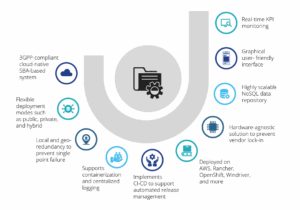
Microservice-based architecture
Employs Microservice-based architecture that aligns with 5G Service-Based Architecture (SBA). Like all 5G NFs, it is implemented using one or more functionally stateless and independent service functions, which integrate with each other and with other vendors’ services over standards-compliant open REST-based APIs.
For persisting application states, a high-performing and scalable NoSQL database is used, which provides a host of benefits compared to other databases. The microservices easily add, test, and reverse incrementally small changes that enable a constantly evolving system.
Cloud-native support
Supports Docker-based containerized deployment for applications or service functions, and provides cloud-agnostic and PaaS-agnostic deployment support. Stateless service functions enable scheduling of automatic scaling based on request traffic load. Can be deployed on the local data center or on multiple cloud systems like OpenStack, AWS, VMware, and more. Also supports VM-and NFV-based deployment.
Convergent SDM
Includes AUSF, UDM+HSS, and UDR. The centralized subscriber data repository helps manage 4G and 5G subscriptions. Supports 4G, 5G NSA, and 5G SA deployments. The convergent solution provides a robust system to simplify the management of multiple diverse partnerships and launch advanced next-gen services like mMTC, massive IoT, URLLC, network slicing, and more.
4G+5G interworking
Includes 4G and 5G NFs that enable operators to provide services over 4G and 5G using the converged core offering. Provides inter-domain mobility that helps support session continuity for subscribers when they switch between 4G and 5G networks. The 3GPP standard-based interface enables deployment with 5G core NFs integrating with the legacy 4G core, and enables interworking with 4G NFs like Mobility Management Entity (MME) using inbuilt Interworking Function (IWF), which facilitates inter-domain mobility and session continuity management.
UE authentication
Enables 4G and 5G authentication by supporting authentication methods for 5G-AKA and EPS-AKA. Supports resynchronization failure management and non-3GPP access authentication.
Service authorization
Manages subscription data, including subscriber identities and service subscriptions, to perform service authorization of 4G and 5G services. Supports privacy protection by implementing SUCI de-concealing (SUCI to SUPI conversion).
Centralized data repository
Includes a common, highly scalable, high-performing subscriber repository for 4G and 5G subscriptions, storing SIM identities, subscription profiles, policies, contexts, sessions, and application states. Provides standard-based API integration to enable other core network nodes to retrieve subscriber information. Supports real-time REST provisioning as well as batch (bulk) provisioning. Supports single- as well as multi-site deployment.
SDM agent portal
Enables effortless import and management of SIM batches through an easy-to-use web portal. Performs service configurations for DNN, slice, APN, and PLMN. Manages 4G and 5G policy subscriptions. Stores SIM information in an encrypted format. Enables troubleshooting for subscription-related issues. Provides a single view of all subscription related information and secures data by granting role-based access with tamper-proof audit logs and operations history.
Enterprise self-service portal
Enabling end-to-end device lifecycle management for enterprise customers through a web-based self-service portal. Supports bulk SIM administration, SIM and service activation, automated provisioning, cost control, subscription management, and real-time usage monitoring. Ensures high levels of security through role-based access and audit logs.
Web-based configurations
Provides a web-based Element Management System (EMS) to enable system users to configure NF services, profiles, and deployments, and add one or multiple microservices, using the same or different functionalities for an NF in an environment. Enables integration with external centralized EMS over NETCONF/YANG.
NRF interworking
Integrates with a 5G Network Repository Function (NRF) or network repository service for NF management and discovery of NF instances, avoiding a single point of failure and handling load balancing of API traffic across NF instances.
Vendor agnostic
Interoperable with any best-of-breed network with a 3GPP-compliant system that supports standard interfaces, giving operators full control to deploy a multi-vendor network to best meet their business needs.
Real-time analytics
Provides event monitoring using various KPIs to help detect system health issues in real-time, helping avert potential problems.
Local and geo-redundancy
Helps ensure high service availability, preventing single points of failure through fault tolerance within geographies and across them.
Benefits of Deploying with Alepo
Efficient deployment
Low footprint: among the lowest in the industry – makes Alepo SDM especially well-suited for edge or enterprise cores as well as ensuring the scalability for a centralized macro core.
Low TTM: our expertise in deploying core network solutions for global networks enables us to ensure swift and easy deployment.
Reliability
Support for all CSPs: our clients include tier-1 operators, ISPs, MNOs, government and state-run networks, utilities, manufacturers, and more.
Scalable solutions: vast experience catering to operators of all sizes.
Flexibility
Multiple deployment options: supports public and private cloud as well as a hybrid deployment
Hardware agnostic: solution is abstracted from the underlying hardware, preventing vendor lock-in.
Clear upgrade path
Future-proof investment: enables a seamless transition to 5G, enabling the operator to evolve swiftly or in phases.
Zero-downtime migration: migrate with minimal impact on existing services and systems.
Secures existing infrastructure: support seamless handover of services between multiple networks (5G, 4G LTE, 2G/3G, WiFi)
Real-Life Deployment
Real-world 5G core applications are already showing positive results. At the 2020 Olympic Games, for instance, Alepo’s 5G core was successfully deployed in the public cloud to swiftly and securely distribute visual content. The objective of the test deployment was to determine viability for large-scale events. A host of media outlets participated in the test, and venues were fitted with 5G base stations from which photographers could upload and transfer large volumes of photographs, videos, and other data to the main press center. Participating members were able to transfer data reliably and quickly, opening a world of opportunity to innovate and develop new use cases by introducing dedicated local 5G at event venues.
Conclusion
5G networks are still in their infancy and will likely work alongside predecessor networks like 4G for at least another few years. So, as CSPs evolve their networks through digital transformation and introduce modern technologies such as virtualization, NFV, containerized deployments, and more, their focus needs to remain on long-term coexistence and interoperability of legacy and next-gen services.
Begin your 5G journey with Alepo.