
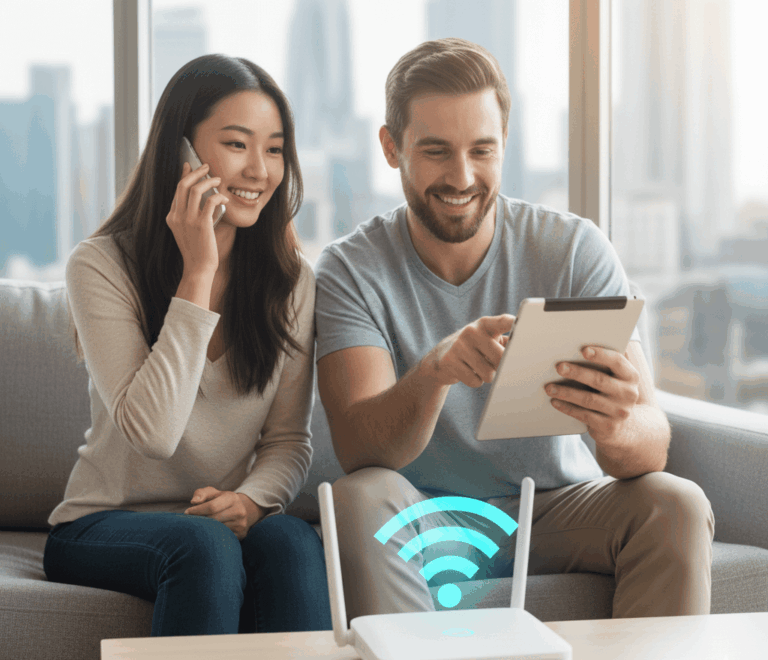
WiFi calling does not require any external application to be installed on a user’s smartphone. Subscribers are reachable on their existing phone number and can place calls via a native dialer built in the phone.
The launch of WiFi calling by T-Mobile in 2014 in the US changed the business landscape for mobile providers. While OTT players like Skype and WhatsApp had been taking market share, presenting WiFi Calling (VoWiFi) as an encroachment on mobile providers’ revenue, T-Mobile showcased that WiFi calling has a place in a mobile operator’s offerings. Instead of a threat, WiFi calling actually presents a unique opportunity for real innovation.
T-Mobile’s move certainly secures WiFi’s position as a mainstream technology. The ubiquity of the iPhone, with its integrated WiFi, made mobile WiFi the norm for smartphone users, making WiFi calling an inevitable reality. For mobile operators, WiFi calling offers a market-ready solution to expand their network coverage, especially indoors, combating OTT players and introducing carrier-class WiFi services into the EPC.
Many operators are switching over to IMS at the moment. A key reason for this transition is that LTE is more spectrum-efficient than previous technologies. And, if the operator has implemented VoLTE, this offers users a truly seamless handoff from cellular to WiFi calls.
WiFi calling is exactly what you are thinking; an IMS-based service that allows you to make and receive calls (and send text messages) over a WiFi network, instead of a traditional mobile network. WiFi calling helps callers place regular phone calls from their SIM-based smartphone in case of poor reception or congestion in the cellular network. This is an operator-provided service and is employed by utilizing a WiFi network.
WiFi calling can be a win-win solution for both subscribers and operators. According to an Ericsson Consumer Lab study, the key reasons users are interested in WiFi calling are those shown in the chart below. Conveniently, these consumer benefits correlate directly with the benefits for operators.
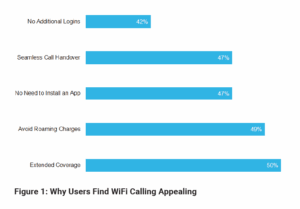
For carriers, these benefits correspond with distinct business gains, such as:
Reduced CAPEX and OPEX: Compared to expanding a cellular mobile network infrastructure, WiFi calling can be a cost-efficient way to extend voice coverage services.
Gain New Revenue Streams: WiFi calling is a great way for operators to reap the benefits of new revenue streams. By offering VoWiFi to their customers, operators instantly gain from the advantages of roaming on untrusted WiFi, increased international use, as well as in-flight VoWiFi calls. Plus, they can offer WiFi calling as a value added service (VAS), either as a standalone add-on, or bundled into other packages. If an operator has their own WiFi network, they can reach a new market segment, previously untapped, by offering access to casual users, who aren’t current subscribers. These casual users can purchase one-time WiFi passes, and make calls if their devices support WiFi calling.
What truly allows operators to compete with OTT (over-the-top) players is the native dialer experience. With WiFi calling, there’s no need to try and juggle contacts, add friends, and download and pay for an app. From an end user’s point of view, it is as simple as “plug-and-play”.
As landline use has dropped over the years, the mobile phone has become the primary contact of consumers. Globally, 60% of consumers are not satisfied with their indoor voice call quality. Consumers make twice as many calls inside as they do outside, which means most consumers are dissatisfied with the quality of the majority of calls they make. A poor connection could tempt a user to switch to another operator. The presence of WiFi, now at almost every home and business, allows providers to salvage and provide better indoor coverage for voice services through WiFi calling. This keeps the customer in focus and makes WiFi calling a customer retention game for mobile operators.
23% of travelers either keep smartphones in airplane mode or simply switch them off for an entire trip. By providing users with the ability to make WiFi calls, and avoid high roaming rates, they will be far more likely to use their phones internationally. This not only boosts usage abroad, but also customer satisfaction, and decreases churn.
With WiFi calling, an operator can ensure secure and transparent connectivity along with seamless handover between LTE and WiFi networks. In doing so, they can have better control over user experience and quality of experience.
Some of the major mobile network operators like AT&T, T-Mobile and EE have started heavily promoting WiFi calling service. It is likely that a major chunk of their subscriber bases will be using this service soon. Getting ahead of the curve will give MNOS “first-mover advantage”. First-movers stand the chance to gain a substantial competitive advantage by establishing themselves before any competitors enter the market. Brand recognition, brand loyalty and more time to refine and perfect services are a few of the perks of being a first-mover.
OTT (over-the-top) VoIP WiFi calling is a cloud-based service, requiring a separate client, and usually does not provide mobility. Carrier WiFi calling, on the other hand, is integrated with the mobile carrier’s network, uses the native dialer on the handset, and is generally an extension of the mobile subscription plan, and usually, includes a seamless mobile experience.
| Category | WiFi Calling (Native) | OTT Voice Calling Apps over WiFi |
| Description | Users’ devices directly access IMS networks to perform voice services with few changes in the core network. Calls will glide from cellular to WiFi and back again without any interruption in service. | This is similar to what Skype calling or a voice call over WhatsApp offers, which works great until you leave the WiFi hotspot. Calls will drop as soon as you are out of WiFi range. It is unavoidable for calls to drop, since there is no seamless handoff from cellular to WiFi. |
| Advantages | • Only IMS network remodeling required. • Unified dialing/message interface. Thus, no need to fire up a third party app. • Voice service continuity can be achieved utilizing the same phone number (seamless handshakes). • Same QoS maintained as that in VoLTE. • Easy set up on the user’s device (just turn on WiFi calling option). | • Easy to deploy. • From a user’s perspective, all he/she needs to do is download the app, register and it’s ready to go. |
| Limitations | • An ePDG needs to be in place. • Limited user devices support WiFi calling, currently the latest models of iPhone, Samsung, LG, HTC to name a few (this list is naturally going to get bigger over the time). | • Not a carrier-class voice solution thus less reliable. • Cannot dispense the same service experience as that practiced in VoLTE. • QoS not guaranteed (no ownership of customer experience). • No general and regulatory services provided (i.e. Emergency calls). • No standards defined. |
There’s no need to worry if there’s no WiFi network infrastructure in place. Mobile operators can opt for WiFi calling without deploying a single WiFi access point or partnering with a WiFi service provider. WiFi calling will work through any WiFi network and primarily through the ones in our homes. Of course, adding more WiFi hotspots will be icing on the cake. Offering WiFi services is probably the best bet for a mobile operator to protect their core business in a WiFi-centric world, which in turn reduces their churn rate when compared to the competition.
A WiFi calling solution for the mobile network operator consists of securely integrating the WiFi network and cellular mobile packet core network using IMS/TAS core elements and subscriber management and billing systems. Refer to Figure 2.
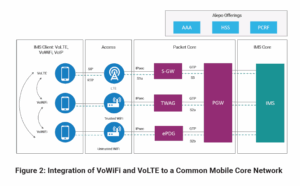
Secure integration between the WiFi network and mobile core relies primarily on two critical components:
ePDG (evolved Packet Data Gateway) for “untrusted” WiFi access points. A network node that allows operators to securely deliver mobile packet core services over untrusted, non-3GPP networks.
TWAG (trusted wireless access gateway) for “trusted” WiFi access points. With trusted access, the user’s device is connected through a TWAG in the WiFi core. The TWAG is in turn connected directly with the P-GW in the EPC through a secure tunnel (GTP, MIP or PMIP).
WiFi access points (APs) typically fall under non-3GPP-defined standards. They are further classified into untrusted and trusted WiFi access points.
The untrusted WiFi access point model was first introduced into the WiFi specification in the 3GPP Release-6 (2005). Untrusted WiFi is typically any kind of WiFi access that the operator has no control over, for example, public hotspots, home, and corporate APs. Untrusted APs generally do not provide adequate security measures to connect to the EPC via authentication and radio link encryption. In order for the user’s device to be securely connected to the mobile packet core, a secure IPsec tunnel between a user’s device and the ePDG must be established. The ePDG is then secured to the mobile packet core (P-GW) through a GPRS tunneling protocol (GTP) tunnel. A Tunnel Termination Gateway (TTG) is used in case of a 3G network. 3GPP IWLAN specifications describe these functionalities in more detail.
A trusted WiFi access point, on the other hand, is often assumed to be part of an operator-built WiFi network. It was first introduced with the LTE standard in 3GPP release-8 (2008) with secure 802.11i airlink encryption in the WiFi radio link. In practice, the WiFi access network must support the following features to be considered trusted:
802.1x-based authentication which in turn also requires encryption of the radio access network (RAN)
3GPP-based network access using the Extensible Authentication Protocol (EAP) method for authentication
IPv4 and/or IPv6
As the link is secure here, there’s no need for a special client on the user’s device. The IPsec tunnel is terminated by the TWAG in this scenario. With full support of the Next Generation Hotspot initiative, Hotspot 2.0 and 3GPP functionalities, trusted Carrier WiFi access using TWAG offers subscribers a truly “cellular-like” seamless roaming experience over both cellular and WiFi networks. User devices will be able to automatically discover and seamlessly make a connection, to the best available WiFi or cellular network with which the subscriber’s home mobile operator has established roaming agreements.
Alepo’s WiFi calling solution offers carriers an opportunity to improve and grow network size and quality with a deployment that is forward-thinking while minimizing system risk and downtime in the transition. A WiFi calling network using Alepo solutions is made up of components which are cost-effective, easy-to-use, and packed with Alepo expertise and authenticity, resulting in a seamless and efficient WiFi experience.
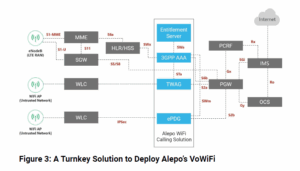
An end-to-end solution can be fabricated with the help of our technical partners in place.
Alepo provides an end-to-end WiFi calling solution with the inclusion of product partners.
A solution that enables Carrier WiFi calling over both untrusted and trusted WiFi networks with the support of ePDG and TWAG respectively (Hotspot 2.0 enabled)
Full integration with the IMS core, which facilitates seamless handovers between VoWiFi and VoLTE networks.
Secure connectivity and authentication for subscribers to transparently roam between 3G, 4G, and carrier WiFi networks.
Support for all 3GPP and 3GPP2 networks.
Minimizes total cost of ownership by optimizing upfront equipment CAPEX and reducing ongoing operational expenses compared to competitors.
Industry-leading scalability with a unique software-based solution.
Reference
https://www.ericsson.com/assets/local/news/2015/7/ericsson-consumerlab- WiFicalling-finds-its-voice.pdf