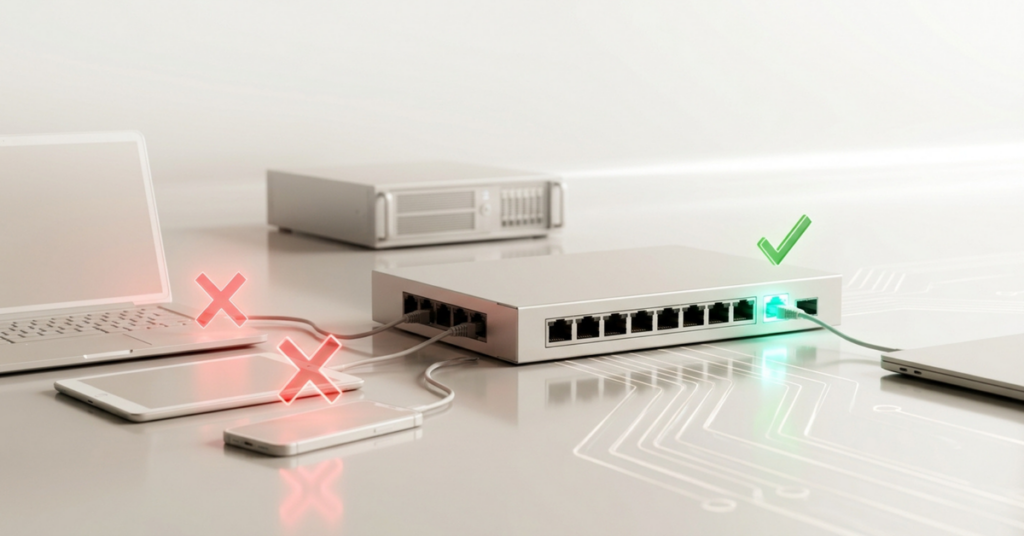
802.1X is the IEEE standard for port-based network access control. It decides whether a device may join a network before the device can send any traffic. A port configured for 802.1X stays closed until the connecting device proves its identity. If authentication fails, the port stays blocked.
The same handshake runs everywhere: a switch port in an office, a wired access node in a broadband network, and a Wi-Fi access point all use 802.1X the same way. For engineers, this is a useful part and a trap. The edge handshake is standardized and largely solved. The harder decision sits behind the RADIUS-based Authentication, Authorization, and Accounting (AAA) server that makes the call, and that gets harder when one operator runs several access types at once.
This guide explains how 802.1X works end to end: the roles, the protocol flow, the EAP methods you choose between, and how the standard behaves on wired, enterprise, and carrier Wi-Fi networks. It then covers the design problem most explainers skip running one AAA across all those access types rather than a separate system per network. The current edition of the standard is IEEE Std 802.1X-2020.
What Is 802.1X Authentication?
802.1X is part of the IEEE 802.1 group of standards. It defines a framework for authenticating and authorizing devices that attach to a local area network (LAN) or wireless LAN, using the physical characteristics of an IEEE 802 network to enforce authentication at the port. An unverified device cannot reach the rest of the network.
Definition: 802.1X is an IEEE standard for port-based network access control that blocks all network traffic from a connecting device until it successfully authenticates against a central AAA server using EAP. A port stays unauthorized, and traffic stays blocked until the authentication server returns a positive result.
Network ports are open by default, a significant risk in enterprise and carrier environments. On a wired network, anyone with physical access to a jack can reach internal systems. The attack class where an intruder connects an unauthorized device to an open port is well documented, and port-based access control is the direct countermeasure. 802.1X turns the port into a gate that opens only after the device proves who it is.
The standard has evolved across editions. 802.1X-2001 introduced the framework. 802.1X-2004 clarified mutual authentication and the relationship with EAP. 802.1X-2010 added an authenticated key agreement to support IEEE 802.1AE MAC Security (MACsec). 802.1X-2020 is the current edition, consolidating those updates. Knowing the edition matters in mixed networks: older equipment may conform to an earlier edition, and the standard is designed so that conformant systems interoperate.
How 802.1X Works: Supplicant, Authenticator, AAA Server
802.1X defines three logical roles. Authentication is complete only when all three agree.
Supplicant — the device requesting access: a laptop, phone, IoT sensor, or any client. It runs supplicant software that responds to the network’s authentication request. Most operating systems include a native supplicant.
Authenticator — the network device that controls the port. On wired networks this is a LAN switch; on Wi-Fi it is an access point or the wireless LAN controller (WLC) behind it. The authenticator does not decide who gets in. It enforces the decision and relays messages.
Authentication server — the system that validates credentials and returns an access decision. In nearly all deployments, this is a RADIUS server (defined in RFC 2865), which runs the chosen EAP method and checks the credential against a directory, certificate authority, or subscriber data store.
The supplicant proves identity, the authentication server judges it, and the authenticator enforces the verdict.
The protocol flow:
802.1X carries EAP the actual authentication exchange over the LAN. This encapsulation is EAP over LAN, or EAPOL. The flow runs as follows:
- The supplicant connects to a switch port or associates with an access point.
- The authenticator requests an identity using EAPOL.
- The supplicant returns its identity, which the authenticator forwards to the RADIUS server inside a RADIUS Access-Request.
- The RADIUS server runs the chosen EAP method, exchanging messages with the supplicant through the authenticator.
- The server returns Access-Accept or Access-Reject.
- On accept, the authenticator opens the port. On reject, the port stays blocked.
802.1X describes each port as having two logical halves. The uncontrolled port carries only EAPOL authentication messages, so the device can prove who it is before it has any network access. The controlled port carries normal traffic and stays blocked until authentication succeeds. The component of managing these states is the Port Access Entity (PAE).
Decisions are not permanent. RADIUS supports Change-of-Authorization (CoA), defined in RFC 5176, which lets the authentication server change or terminate a live session, apply a new policy, move a device to a quarantine segment, or disconnect it. CoA is the mechanism behind real-time session control, and it matters on wired networks as much as on Wi-Fi.
EAP Methods Used with 802.1X in Telecom
802.1X does not authenticate itself. It transports whichever EAP method you select, and that choice is the most consequential security decision in the design.
EAP-TLS — mutual, certificate-based authentication. Both client and server present certificates, so there is no shared password to steal or crack. It is the strongest common method and a foundation for zero-trust designs. The cost is a certificate of lifecycle management at scale.
PEAP and EAP-TTLS — tunneled methods that build a TLS tunnel with a server certificate, then carry an inner credential exchange inside it. They avoid client certificates, but the inner method matters inner methods based on MS-CHAPv2 have known weaknesses against credential cracking, so stronger inner methods or a move to EAP-TLS is current best practice.
EAP-SIM, EAP-AKA, EAP-AKA — SIM-credential methods used for carrier Wi-Fi and Wi-Fi offload, validated against the operator’s subscriber identity store. EAP-AKA (EAP-AKA Prime) is the current preferred variant: it adds key derivation improvements for 5G and non-3GPP access contexts and is stronger than legacy EAP-SIM.
MAC-based authentication — a fallback for devices that cannot run a supplicant, such as printers and some IoT endpoints. The device is identified by its MAC address rather than a credential. It is weaker than EAP and should be scoped tightly.
Methods are commonly layered: certificate-based or SIM-based authentication for primary devices, with MAC-based authentication or a guest path for endpoints that cannot authenticate normally.
802.1X for Carrier WiFi
On Wi-Fi, 802.1X is the enterprise authentication mode. WPA2-Enterprise and WPA3-Enterprise both use 802.1X with a RADIUS server, which is what separates them from the shared-password personal mode. The access point or WLC acts as the authenticator and relays EAP to the RADIUS server.
For operators, the wireless case becomes a subscriber-scale problem. Carrier Wi-Fi, Wi-Fi calling, and Wi-Fi offload authenticate large numbers of subscriber devices, often with SIM credentials over EAP-SIM, EAP-AKA, or EAP-AKA. This requires the AAA layer to validate the SIM credential against the subscriber identity store the HLR (Home Location Register) or HSS (Home Subscriber Server) and, for voice over Wi-Fi, to interwork with the mobile core over Diameter interfaces such as SWx, SWm, and S6b. The practical benefit is automatic onboarding: a subscriber device authenticates with the SIM already in it, with no separate Wi-Fi password.
Three carrier Wi-Fi use cases run on the same 802.1X backbone, each with different EAP and backend requirements:
Wi-Fi monetization (hotspot and venue Wi-Fi) typically pairs with a captive portal with EAP-PEAP or EAP-TTLS. Once a subscriber registers, subsequent visits auto-authenticate. The AAA server enforces plan policy, bandwidth limits, session duration, quota, via RADIUS attributes returned to the Access-Accept and handles mid-session enforcement through CoA when subscribers exhaust their allowance.
Wi-Fi offload removes the login step entirely. Using Hotspot 2.0/Passpoint with EAP-SIM or EAP-AKA, devices discover operator Wi-Fi networks and authenticate automatically using SIM credentials. The AAA server retrieves authentication vectors from the HSS over the Diameter. From the subscriber’s perspective, Wi-Fi behaves like an extension of the mobile network.
Wi-Fi calling (VoWiFi) adds Diameter interface requirements. Trusted access via TWAG uses the STa interface; untrusted access via ePDG uses SWm. EAP-AKA’ is the authentication method of choice. The AAA server sits between the ePDG or TWAG and the HSS, authenticating the subscriber and establishing the security associations that protect voice traffic over Wi-Fi.
Operators running Alepo AAA for carrier Wi-Fi get a single platform covering all three use cases WLC integration with Cisco, Aruba, Ruckus, Cambium, and Ubiquiti, active-active geo-redundant clustering, and Diameter interfaces for VoWiFi, without separate authentication systems per use case.
802.1X for Wired Telecom Networks
802.1X started on wired Ethernet, and the wired case is where many operator and enterprise deployments live. When a device connects to a port configured for 802.1X, the port stays unauthorized until the device is authenticated. This stops an unauthorized device from reaching the network by connecting to a wall jack with a real concern in offices, branch sites, retail locations, and shared facilities.
Wired 802.1X does more than open or close a port. On Access-Accept, the RADIUS server can return attributes that place the device on a specific VLAN or apply an access control list. This turns authentication into segmentation: a contractor laptop, a corporate device, and an IoT sensor can each land on a different network segment from the same physical port, decided by policy rather than cabling.
Two adjacent controls frequently sit alongside wired 802.1X:
TACACS+ for device administration. 802.1X controls which devices reach the network. TACACS+ controls which people can administer the network equipment, with command-by-command authorization and audit logging. They solve different problems and frequently run on the same AAA platform.
MACsec for link encryption. For higher-assurance wired links, 802.1X-2010 introduced MACsec Key Agreement (MKA), which establishes the keys used by IEEE 802.1AE MACsec to encrypt traffic on the wire between authenticated peers’ protection beyond simply controlling port access.
For broadband operators, the same RADIUS authentication and accounting model extends to FTTx, cable, and DSL subscriber access at the network edge, where BRAS/BNG nodes authenticate sessions and generate accounting records that feed directly into the BSS for billing.
RADIUS and 802.1X Integration
RADIUS is the protocol that carries 802.1X authentication between the authenticator and the AAA server. The two are separate specifications that work together. Understanding the boundary between them is essential when troubleshooting or scaling a deployment.
When the authenticator forwards an EAP message upstream, it wraps it inside a RADIUS Access-Request packet (defined in RFC 2865). That packet carries the EAP payload, the NAS-IP-Address identifying the authenticator, the NAS-Port-Type specifying whether this is wireless or Ethernet, and optionally the Calling-Station-Id (the client’s MAC address) and Called-Station-Id (the AP’s MAC and SSID). These attributes let the AAA server apply for per-device or per-SSID policy without a separate request.
The server responds with Access-Challenge packets carrying EAP-Request messages while the method of exchange runs. Once complete, Access-Accept carries the session of policy attributes back to the authenticator. Standard attributes handle the basics, Session-Timeout, Idle-Timeout, and Class. VSAs (Vendor-Specific Attributes) handle vendor-specific session configuration.
VLAN assignment uses three attributes from RFC 2868: Tunnel-Type (value: VLAN), Tunnel-Medium-Type (value: 802), and Tunnel-Private-Group-ID (the VLAN ID or name). The authenticator reads these from the Access-Accept and places the authenticated session on the specified VLAN immediately; no static per-port configuration required.
Dynamic Authorization (CoA) defined in RFC 5176, extends the model beyond initial authentication. The AAA server sends CoA-Request messages to modify a live session or Disconnect-Request messages to terminate one. This is how mid-session enforcement works: quota exhaustion triggers a CoA, not a re-authentication.
RadSec — RADIUS over TLS, defined in RFC 6614 is relevant for operators routing authentication traffic across untrusted network segments or inter-domain roaming scenarios. It adds encryption and reliable transport, addressing two of plain RADIUS/UDP’s weaknesses.
At carrier scale, RADIUS runs over UDP, and the AAA platform compensates with application-level retransmission, active-active clustering with synchronized session state, and load-balanced RADIUS proxy tiers. The target is typically sub-100ms per authentication transaction end-to-end. At millions of authentications per day, the AAA platform’s throughput and latency characteristics measured in transactions per second (TPS) are as operationally significant as its functional capabilities.
Carrier-Grade 802.1X Deployment
For a Communications Service Provider, wholesale broadband operator, or managed-network provider, the 802.1X handshake at the edge is rarely the hard part. Deploying it at a carrier scale means solving problems that enterprise AAA platforms aren’t built for.
Most operators do not run a single access type. They run several, wired enterprise access, public and carrier Wi-Fi, FTTx broadband, and mobile data, and each generates authentication requests. Running a separate AAA per access type creates three compounding problems:
Vendor and operational sprawl.
A separate AAA per access type means more systems to run, more failure domains, and inconsistent policy across networks.
Fragmented protocol coverage.
Wired and Wi-Fi deployments need the full EAP family and RADIUS with CoA. Carrier and converged networks additionally need Diameter and RadSec for inter-domain traffic. Device administration needs TACACS+. Few single-purpose systems cover all of these.
Multiplied availability risk.
Authentication sits in the path of every connection. Each separate system is its own availability project. Consolidating onto one platform with active-active geo-redundant clustering across regions reduces that risk to a single, well-managed availability perimeter.
Common deployment pitfalls at scale:
Certificate lifecycle.
EAP-TLS is only as reliable as the certificate of management behind it. Expired or unrevoked certificates cause both outages and security gaps.
Weak inner methods.
Tunneled methods are convenient, but legacy inner methods based on MS-CHAPv2 are vulnerable. Plan for stronger inner methods or certificate-based authentication in new deployments.
Realm and attribute mismatches.
Across multiple access types, requests carry different realms and attributes. A missing or wrong attribute produces a reject that looks like a credential failure but is a policy or routing issue.
Timeouts under load.
Misconfigured EAP or RADIUS timers cause authentication to fail under peak load even when credentials are valid, showing up as intermittent rejects that are hard to trace.
Devices without supplicants.
IoT and legacy endpoints that cannot run a supplicant need a planned fallback, MAC-based authentication or a segmented guest path, or they get locked out.
Consolidating authentication onto one standard-based platform addresses all of these. One AAA that terminates RADIUS, Diameter, and TACACS+, supports the full EAP family, and runs active-active across regions becomes the single decision point behind 802.1X whatever the access type. The edge handshake stays standard; the back-end stops being many systems and becomes one.
Alepo AAA is built for this consolidation. It terminates RADIUS, Diameter, and TACACS+ on a single stack, supports EAP-SIM, EAP-AKA, EAP-AKA’, EAP-TLS, EAP-TTLS, and EAP-PEAP alongside PAP/CHAP and MAC-based authentication, and integrates with WLC vendors including Cisco, Aruba, Ruckus, Cambium, and Ubiquiti and with BRAS/BNG platforms for broadband access. Operators across the Middle East (STC, Etisalat), Europe, and LATAM (Telefónica) run Alepo AAA for carrier-grade 802.1X and EAP authentication across WiFi, broadband, and mobile access.
Explore the Alepo AAA Server or request a demo.
Frequently Asked Questions
What is 802.1X in simple terms?
It is a standard that makes a device prove its identity before it can use a network port, wired or wireless. If the device cannot authenticate, the port stays blocked.
Is 802.1X the same as RADIUS?
No. 802.1X is the access-control standard at the network edge. RADIUS is the protocol used to reach the authentication server that makes the decision. They work together: 802.1X carries the request over EAPOL, and RADIUS delivers it to the AAA server.
What is the difference between 802.1X and EAP?
EAP is the authentication exchange itself. 802.1X, through EAPOL, is the encapsulation that lets EAP run over a LAN. 802.1X transports EAP; it does not replace it.
Does 802.1X work on both wired and wireless networks?
Yes. It applies to wired LAN switch ports and to Wi-Fi. On Wi-Fi it is the basis of WPA2-Enterprise and WPA3-Enterprise. On wired networks it can also drive dynamic VLAN assignment and segmentation through RADIUS attributes.
Can one AAA server handle wired, Wi-Fi, and mobile authentication together?
Yes, if it covers the right protocols. Wired and Wi-Fi need the full EAP family and RADIUS with Change-of-Authorization; carrier and converged networks also need Diameter and RadSec; device administration needs TACACS+. A platform covering all of these can act as the single authentication server across access types, instead of running a separate system per network.
Which EAP method should a telecom operator use?
It depends on the credentials in play. Certificate-based EAP-TLS suits device authentication and zero-trust designs. SIM-based methods — EAP-SIM, EAP-AKA, EAP-AKA, suit carrier Wi-Fi and Wi-Fi offload. Tunneled methods such as PEAP and EAP-TTLS are common where certificates are not practical, with attention to the inner method chosen.
Why does the AAA back-end matter more than the 802.1X edge?
The edge handshake is standardized and largely solved. The back end must authenticate every connection across multiple access types, stay available during peak traffic, and integrate with directories, subscriber data, and the mobile core. That is where scale, availability, and protocol coverage decide whether the deployment holds up.
How does an AAA server support 802.1X for both wired and wireless networks?
The AAA server handles both through RADIUS, the same protocol used by Ethernet switches, BRAS/BNG systems, and wireless LAN controllers alike. The authenticator type doesn’t matter to the AAA server; it sees RADIUS Access-Requests with NAS-Port-Type attributes that identify whether the request came from a wired or wireless access point. A single carrier-grade AAA can concurrently terminate wired broadband (PPPoE/IPoE via BRAS), carrier WiFi (EAP-SIM/AKA/AKA’ via WLC), and network device administration (TACACS+).
What is RADIUS CoA used for 802.1X networks?
CoA (Change-of-Authorization), defined in RFC 5176, lets the AAA server modify or terminate an active subscriber session without re-authentication. The server sends a CoA-Request to the authenticator’s NAS port to identify the target session. Common uses: enforcing data quota exhaustion mid-session, applying an updated service policy when a subscriber changes plan, and terminating sessions flagged by threat detection as suspicious.
What VLAN assignment capabilities does 802.1X AAA provide?
VLAN assignment uses three RADIUS attributes from RFC 2868: Tunnel-Type, Tunnel-Medium-Type, and Tunnel-Private-Group-ID. The AAA server includes these in the Access-Accept response, and the authenticator places the authenticated session on the specified VLAN immediately. This enables dynamic subscriber segmentation by service tier, subscriber type, or tenant without static per-port configuration.
Conclusion
802.1X handles authentication before the network lets anything go through. For telecom operators, that makes it foundational infrastructure not a feature layer. The same standard covers carrier WiFi, broadband subscriber access at the BRAS, and privileged access control for network devices. The EAP method changes by use case. The underlying framework is not.
Where deployments run into problems is rarely the 802.1X standard itself. It’s the AAA platform underneath: whether it handles the throughput, keeps sessions synchronized under failure conditions, routes correctly across multiple realms, and integrates cleanly with the HSS, PCRF, and BSS. Those are the requirements that separate a carrier-grade platform from something that works well in an enterprise but strains under operator conditions.
Request a Demo — see how Alepo AAA handles 802.1X across your access topology.