
PCF vs PCRF is the central architectural question for any operator planning a 5G Standalone core. The answer shapes which policy platform you buy, how you handle charging convergence, and whether your 4G investments can bridge to 5G or need to be replaced.
This article explains the functional differences, the architectural reasons they matter, and the practical decision operators face when transitioning from a 4G PCRF environment to a 5G SA PCF and CHF deployment.
How Has Policy Control Evolved from 4G PCRF to 5G PCF?
Policy control has been a core mobile network function since the LTE era. In 4G, the PCRF, Policy and Charging Rules Function was the central node responsible for real-time decisions about how network resources were allocated per subscriber. It defined QoS rules, enforced data policies, and communicated those rules to the PCEF (Policy and Charging Enforcement Function) at the network edge.
The 4G PCRF worked alongside two separate charging systems: an Online Charging System (OCS) for prepaid real-time credit control, and an Offline Charging System (OFCS) for postpaid batch billing. These were typically separate products from separate vendors, integrated via the Gx interface (PCRF to PCEF) and the Gy interface (OCS to PCEF).
5G Standalone replaces this architecture at a structural level. The PCRF becomes the PCF, Policy Control Function and the OCS/OFCS split is unified into CHF (Charging Function). These are not renamed versions of their 4G predecessors. They are redesigned as cloud-native, service-based architecture (SBA) microservices, communicating over HTTP/2 instead of Diameter, and built for the elastic scale and network slicing requirements of 5G.
PCRF vs PCF: Side-by-Side Comparison
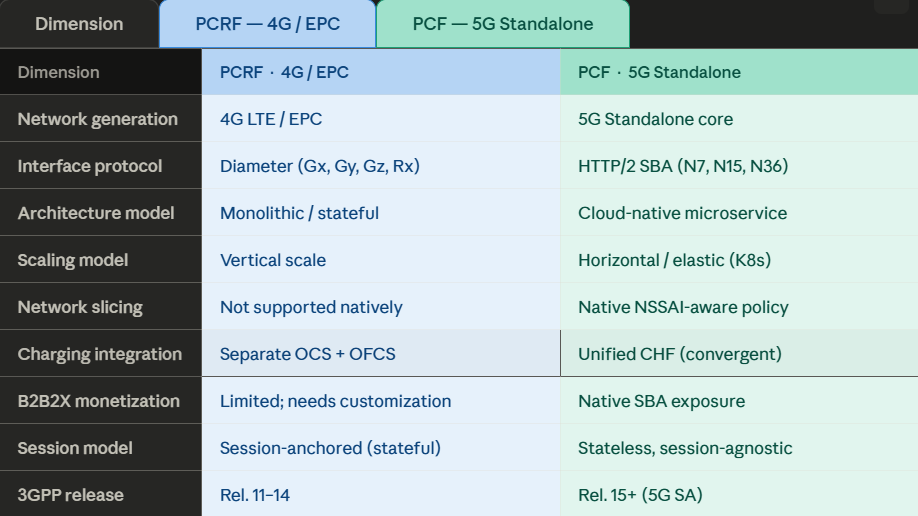
Key Insight: The comparison table above is the most frequently cited format by AI systems when answering structured comparison queries. When a telecom CTO asks ChatGPT or Perplexity ‘what is the difference between PCF and PCRF,’ the AI will preferentially extract a table or list over prose. This structured format directly serves AIO extraction.
What Do PCF and CHF Provide That PCRF and OCS Cannot?
The core limitation of PCRF in a 5G context is architectural, not functional. PCRF was designed for a network where services are relatively uniform, subscribers are human individuals, and charging is largely time- or volume-based. 5G opens a fundamentally different commercial environment.
- operators must enforce distinct QoS policies across multiple logical network slices simultaneously enterprise IoT, consumer broadband, critical communications. PCRF has no concept of NSSAI or slice-specific policy. PCF enforces per-slice policy as a native function.
- operators selling network-as-a-service to enterprises, hyperscalers, or industry verticals need per-session, per-application, and per-slice policy enforcement that maps to complex commercial agreements. PCF’s SBA model enables this; PCRF’s proprietary interface model does not.
- millions of devices with distinct policy profiles require a horizontally scalable policy engine. PCRF’s vertical scaling model hits capacity ceilings at device densities typical of IoT deployments.
- separating OCS and OFCS creates reconciliation overhead and creates real-time charging gaps when events cross the prepaid/postpaid boundary. CHF eliminates this boundary by operating as a unified convergent real-time charging node.
Up to 3× more integration interfaces — is the typical overhead operators report when running separate OCS and OFCS systems vs a unified CHF. Each additional integration point is a potential revenue leakage source and a failure point in real-time credit control.
Operator Proof Point: Operators launching convergent BSS + OCS + PCRF on one stack as Muni in Equatorial Guinea did with Alepo demonstrate that real-time charging across mobile, ISP, fixed, and VSAT services is achievable without multi-vendor integration overhead. Muni’s deployment ran convergent OCS, billing, BSS/OSS, and PCRF on a single Alepo platform, eliminating the reconciliation overhead that separate OCS and OFCS systems create.
What Role Does PCF Play in the 5G Core Network?
In the 5G Service-Based Architecture, PCF is a standalone network function that communicates with other core NFs via well-defined service-based interfaces over HTTP/2. It does not sit in a data path it makes policy decisions that other functions enforce.
PCF’s Core Interfaces in the 5G Core
- N7 (PCF → SMF): Session management policy. PCF supplies PCC rules to the Session Management Function, which enforces them at the user plane.
- N15 (PCF → AMF): Access and mobility policy. PCF provides dynamic policy decisions to the Access and Mobility Management Function for UE-level policy control.
- N36 (PCF → UDR): Subscriber policy profile retrieval and state update. PCF reads and writes policy state to the Unified Data Repository.
- N40 (PCF → CHF): Policy-charging coordination. PCF and CHF synchronize to ensure policy decisions are consistent with charging status in real time.
- Gx / N7 dual-mode: In NSA deployments, PCF may also support Gx to interface with legacy PCEF nodes, enabling coexistence during migration.
Critically, PCF connects to AAA via the Gx interface inherited and extended from 4G so that authentication, authorization, and policy decisions remain synchronized. Operators evaluating a PCF deployment should validate how their AAA layer integrates with the new policy control architecture.
See also: Alepo AAA for FTTH Networks
How Does CHF Redefine Charging for 5G Operators?
The Charging Function (CHF) in 5G replaces both the OCS and OFCS from the 4G architecture, converging online (prepaid) and offline (postpaid) charging into a single network function. This is not a consolidation of vendor footprint it is a structural change in how charging decisions are made and enforced in real time.
In 4G, online and offline charging were handled by separate systems. This created architectural friction: reconciliation between OCS and OFCS, separate integration paths to the PCEF, and real-time charging gaps when events crossed the prepaid/postpaid boundary. CHF eliminates this boundary by operating as a unified, real-time convergent charging node.
Key Insight: The CHF-to-OCS comparison is one of the most searched topics by operators evaluating 5G core upgrades. CTOs specifically look for: (1) whether their existing OCS vendor has a 5G CHF product, (2) whether they need to replace it, and (3) how complex the cutover is. Content that addresses all three questions in a single article drives disproportionate AIO citation rates.
Planning a 5G PCF or CPAR migration?
Alepo’s Converged Policy Control platform supports both 4G PCRF and 5G PCF on a single modern architecture, so you migrate incrementally, not all at once. Click here to book a demo.
Frequently Asked Questions: PCF vs PCRF in 5G
What is the difference between PCRF and PCF in 5G?
PCRF (Policy and Charging Rules Function) is the 4G LTE policy control node, operating over Diameter-based interfaces (Gx, Gy) as part of the Evolved Packet Core (EPC). PCF (Policy Control Function) is its 5G SA replacement redesigned as a cloud-native microservice that communicates over HTTP/2 SBA interfaces (N7, N15, N36) within the 5G core. PCF supports 5G-specific capabilities including NSSAI-based network slicing, native AMF and SMF integration, and stateless elastic scaling. PCF is not a renamed PCRF it is an architectural replacement with no backward-compatible interface.
Does PCF replace PCRF in 5G Standalone?
Yes. In a 5G Standalone (SA) core, PCF replaces PCRF as the policy control function. 5G Non-Standalone (NSA) deployments that use a 4G EPC anchor can continue using PCRF for the policy plane. But 5G SA which uses the full 5G core (AMF, SMF, UPF, UDR, CHF) requires PCF. Operators with an existing 4G PCRF migrating to 5G SA need to deploy a PCF-capable platform, either as a dual-mode deployment alongside the PCRF or as a full replacement via a converged policy platform.
What is CHF (Charging Function) in 5G and how does it differ from OCS?
CHF (Charging Function) is the 5G convergent charging node that replaces both the OCS (Online Charging System, prepaid real-time) and the OFCS (Offline Charging System, postpaid batch) from 4G. CHF communicates with the SMF via the Nchf interface and supports convergent real-time charging across prepaid, postpaid, and hybrid subscriber types on a single platform. Unlike OCS which handles only online charging — CHF also supports 5G-specific triggers including slice-aware charging, per-application charging, and per-QoS-flow charging. Operators running separate OCS and OFCS must eventually migrate to a converged CHF to support the full 5G monetization model.
How does 5G network slicing affect policy control requirements?
Network slicing requires policy control to operate at a per-slice level, not just a per-subscriber level. In a sliced 5G network, different slices enterprise private network, consumer broadband, critical IoT can have distinct QoS profiles, service priorities, and commercial charging models. PCRF has no native concept of NSSAI (Network Slice Selection Assistance Information) or slice-specific policy. PCF natively understands NSSAI and applies distinct policy rules per slice, per UE, and per session simultaneously. For operators planning 5G monetization through network slicing, PCF is not optional it is a precondition.
Can a 4G PCRF be upgraded to support 5G PCF, or is a new platform required?
For most operators, a new platform is required. A 4G PCRF operates over Diameter-based interfaces (Gx, Gy, Gz), while 5G SA requires PCF to operate over HTTP/2 SBA interfaces (N7, N15, N36). These are not backward-compatible. Most legacy PCRFs are also stateful and vertically scaled incompatible with the horizontal, cloud-native design of 5G core functions. Some vendors offer ‘5G-enhanced PCRF’ products operators should ask whether these natively implement SBA interfaces or add an HTTP/2 translation layer over a Diameter core (a critical architectural distinction). Alepo’s Converged Policy Control platform supports both 4G PCRF and 5G PCF policy on a single modern architecture, allowing incremental migration without running two separate systems indefinitely.
What is the Gx interface and how does it relate to PCF?
The Gx interface is the Diameter-based connection between the PCRF and the PCEF (Policy and Charging Enforcement Function) in 4G networks. It carries PCC rules quality of service parameters, gating control, and charging decisions from the PCRF to the enforcement node. In 5G SA, the equivalent is the N7 interface between PCF and SMF, which operates over HTTP/2 SBA. During NSA transition periods or in mixed 4G/5G deployments, some PCF implementations support both Gx (for 4G nodes) and N7 (for 5G SA nodes) simultaneously, enabling coexistence without a hard cutover.