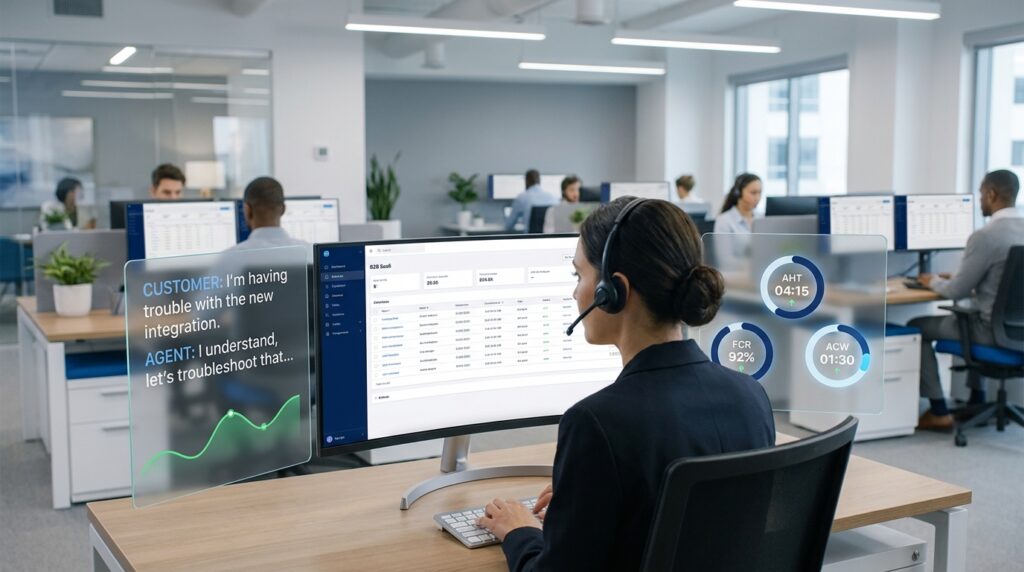
Call center performance management is the practice of measuring and improving how a contact center handles customer interactions — Average Handle Time (AHT), First Contact Resolution (FCR), After Call Work (ACW), Customer Satisfaction (CSAT), and more. AI for call centers changes this practice in two ways: it gives supervisors real-time visibility instead of after-the-fact dashboards, and it gives agents on-call assistance that improves the metric while the call is still happening. The result is a performance system that does not just measure outcomes, but shapes them as they occur.
What Is Call Center Performance Management — and Why Do Traditional Approaches Fail?
Call center performance management is the operating system of a contact center. It is how a CX leader answers four questions every week:
- Are agents resolving issues quickly?
- Are customers getting accurate answers the first time?
- Where are calls leaking — into escalation, repeat contact, or churn?
- Which agents need coaching, and on what?
Traditional performance management answers these questions with lagging indicators. Supervisors review yesterday’s AHT, last week’s CSAT, last month’s FCR. They run quality assurance on a sample of recorded calls — typically a small fraction of total volume. They coach agents in monthly one-on-ones based on calls that happened weeks earlier.
This model has three structural problems.
First, the sample is too small. QA teams review a fraction of calls. The vast majority of agent behavior is invisible to the performance system. A coaching plan built on that thin a slice of evidence is a guess.
Second, the feedback loop is too slow. An agent who mishandles a billing dispute on Monday may not hear about it until Friday’s review meeting. By then they have repeated the same mistake on dozens of calls. The cost of slow feedback compounds.
Third, the data is fragmented. AHT lives in the dialer. CSAT lives in the survey tool. Ticket data lives in the CRM. Sentiment lives nowhere — or in a quality reviewer’s head. Stitching this together for a single agent, a single team, or a single day is a manual exercise.
AI for call centers is the practical answer to all three problems. It listens to every call, not a sampled subset. It surfaces feedback during the call, not weeks later. And it joins the data sources together into one view of agent and customer performance.
Which KPIs Matter Most in Contact Center Performance Management?
The KPIs that matter are the ones tied to cost, retention, and revenue. AI changes how each one is measured and how quickly it can be improved.
| KPI | What it measures | What AI changes |
|---|---|---|
| Average Handle Time (AHT) | Total time on a call, including hold and transfer | Real-time agent assist surfaces answers and next steps mid-call, reducing search and hold time |
| First Contact Resolution (FCR) | Share of issues resolved on the first interaction | Conversation analytics flags unresolved intents and predicts repeat-contact risk before the call ends |
| After Call Work (ACW) | Time spent on notes and disposition after the call | AI summarization auto-drafts call notes and ticket dispositions, recovering minutes per call |
| Customer Satisfaction (CSAT) | Post-call survey score | Sentiment analysis on the call itself gives a signal on every call, not just the small share that complete a survey |
| Escalation rate | Share of calls handed to Tier-2 or supervisors | Knowledge retrieval at the agent’s desk reduces escalations driven by information gaps |
| Churn signal | Customers likely to leave after a call | Conversation analytics flags churn-risk language and routes to retention workflows |
AI contact center analytics changes the measurement model from sample-based to comprehensive. Every call is transcribed, analyzed, scored, and tagged. The dashboard a CX leader sees on Monday morning reflects all of last week’s calls, not the fraction a QA team had time to review.
How Does AI for Call Centers Improve Performance at Scale?
AI call center automation works on three layers. Each layer addresses a different part of the performance equation.
Layer one: self-service deflection. AI customer assistants handle routine inquiries — balance checks, plan changes, address updates, password resets, simple troubleshooting — without an agent. The calls that reach agents are the ones that genuinely require human judgment. This shifts the AHT and FCR baseline upward, because agents are no longer averaging in two-minute balance-check calls.
In Alepo’s BSS stack, the AI Customer Assistant is built into the self-care experience. It speaks the customer’s language, draws from the operator’s billing and product catalog data, and hands off to a live agent with full context when escalation is needed. Alepo’s AI Customer Assistant is documented to reduce support call volume by up to 60%.
Layer two: agent-side automation. When a call does reach an agent, the second layer takes over. Routine tasks the agent used to do manually — pulling up customer history, checking entitlements, drafting a follow-up email, logging the ticket — are automated. The agent focuses on the conversation. The system handles the disposition work.
Layer three: workflow-level automation. Beyond individual calls, AI call center automation closes the loop into the BSS itself. A churn signal triggers a retention offer in the campaign engine. A failed payment triggers a dunning workflow. A ticket pattern triggers a product issue in the trouble ticketing module. The contact center stops being a cost center reporting to operations and starts being a control surface for the rest of the business.
How Does Real-Time Agent Assist AI Improve Call Center Performance During Live Calls?
Agent assist AI is the single highest-impact tool a contact center can deploy. It works in real time, on the call, while the agent is talking.
The mechanics are straightforward. AI listens to the conversation. It identifies the customer’s intent. It searches the operator’s knowledge base — product manuals, troubleshooting guides, billing rules, policy documents — and surfaces the relevant answer to the agent’s screen. The agent does not have to search. The answer is there.
For a complex telecom call — a roaming dispute, a 5G plan change, a device troubleshooting case — this matters in three ways:
- Time. The agent does not put the customer on hold to search.
- Accuracy. The answer is pulled from a current, governed source, not an agent’s memory of a policy that changed last quarter.
- Consistency. Two agents asked the same question give the same answer, because both are reading from the same retrieved source.
The Alepo AI Agent Assistant is built into the BSS workflow. When an agent picks up a call, the assistant already has the customer’s account context — plan, billing status, recent tickets, open cases. As the conversation develops, the assistant retrieves the relevant article, drafts the resolution steps, and prepares the post-call ticket disposition. The agent’s job becomes the conversation, not the lookup.
This is also where AI knowledge base assistants earn their place. A knowledge base that no one reads is a sunk cost. A knowledge base that an AI reads on every call, on behalf of every agent, becomes the operational core of the contact center.
For deeper detail on how this works in production, see Alepo’s AI Agent Assistant and AI Customer Assistant pages.
What Does Omnichannel Performance Management Look Like with AI?
A modern contact center is not a call center. It is a multi-channel operation — voice, chat, WhatsApp, social, email, in-app messaging. A customer might start in self-service chat, escalate to WhatsApp, and finally reach voice. The performance management system has to follow the customer across all of it.
Omnichannel performance management with AI rests on three principles.
One conversation, not many. The system treats a customer’s interactions across channels as a single thread. When the customer reaches an agent, the agent sees the chat transcript, the self-service attempts, and the prior tickets — without asking the customer to repeat themselves. AHT drops because context is preserved.
Consistent intent recognition across channels. The same AI that classifies intents in voice classifies them in chat and messaging. CX leaders can compare resolution rates, escalation rates, and CSAT across channels using comparable definitions, not channel-specific guesses.
Performance metrics that account for channel mix. A customer resolved in self-service chat is not the same outcome as a customer resolved in a 12-minute voice call, even if both count as FCR. AI-driven analytics can weight the channel mix and surface the real cost-to-serve per resolved interaction. CX leaders make routing decisions based on what actually serves the customer at the lowest cost, not on which queue happens to be empty.
For a CSP whose existing CCaaS platform handles the routing, recording, and basic reporting but lacks a deep AI layer, the practical question is how to add AI performance management without rebuilding the contact center. The Alepo AI CCaaS Assistant is purpose-built for that scenario. It sits over the existing CCaaS, integrates through APIs, and brings the AI Customer Assistant and AI Agent Assistant into the agent desktop. The operator keeps the CCaaS investment and gains the AI capability — without a two-vendor integration project.
FAQ:
What is the single biggest impact AI has on call center performance?
Real-time agent assist. It compresses handle time and improves accuracy on the same call where the cost is incurred. Every other AI use case — self-service, analytics, automation — adds value, but agent assist is the one that changes the per-call economics during the call itself.
Can AI fully replace human agents in a contact center?
No, and operators that try usually walk it back. AI handles routine, high-volume, predictable interactions well. Complex disputes, sensitive accounts, retention conversations, and edge-case troubleshooting still need human judgment. The practical model is AI handling the routine layer and AI assisting humans on the complex layer. The agent is amplified, not removed.
How long does it take to deploy AI performance management in a contact center?
It depends on the starting point. Operators with a clean knowledge base and a modern CCaaS can deploy an AI overlay in weeks. Operators with scattered documentation, multiple legacy systems, and no API surface should expect a longer onboarding — the work is in the data, not the AI.
Conclusion
Call center performance management used to be a backward-looking discipline. Reports on what happened. Coaching on what already went wrong. AI changes the time horizon. The metric is shaped in real time on the call, by an agent who has the right information and an assistant that is paying attention to the conversation.
To see how Alepo’s AI Agent Assistant and AI Customer Assistant work in a telecom contact center, book a demo.