
What Is AI Sales Automation for Telecom?
AI sales automation allows telecom operators to qualify website visitors, answer complex product questions, schedule meetings, and log leads to Customer Relationship Management (CRM) systems automatically, 24/7, without a human rep. Unlike generic chatbots, telecom-trained AI understands the full complexity of Business Support Systems (BSS), Authentication, Authorization, and Accounting (AAA), and AI CX portfolios. Communications Service Providers (CSPs) using AI sales assistants report significant improvements in lead conversion speed, first-contact resolution, and churn reduction within weeks of deployment.
The Core Idea: Qualify, Respond, Convert Without a Human Rep
A website visitor arrives at 2 a.m. in Singapore. Your sales reps are offline. In a traditional model, that lead waits until Monday morning or fills in a form and disappears. With AI sales automation for telecom, that visitor is qualified in real time, walks through product options relevant to their network type, and books a meeting with your Account Executive (AE) — all before your team wakes up.
Why Is the Telecom Sales Process So Complex to Automate?
The telecom sales process is complex to automate because deals involve long cycles of 6–18 months, multi-stakeholder buying committees, and technically deep product portfolios that generic AI tools were never designed to handle. Most AI sales platforms are built for SaaS they fail the moment a CSP prospect asks a serious question about BSS architecture or AAA integration. Telecom requires a purpose-built approach.
Complex Products: AAA, BSS, AI CX — Not a Commodity Sale
A CSP evaluating a BSS replacement or an AAA upgrade is not buying a subscription. They are making a multi-year infrastructure decision. The product questions are technical, the stakeholders are multiple, and a generic chatbot that responds with “Tell me more about your needs” is not going to cut it. AI sales automation for telecom needs to understand product catalog depth and guide a Chief Technology Officer (CTO) through meaningful discovery — not just collect a name and email.
Long Sales Cycles (6–18 Months) and Committee Buying
Telecom deals are not closed by one person. A CTO, VP of Operations, and Head of Finance are all involved. The sales process runs 6–18 months and requires consistent engagement across that entire period. AI automation in this environment means staying in front of every stakeholder with relevant content and timely follow-up not just answering the first question.
24/7 Global Coverage Across Time Zones and Languages
Telecom operators are global. A prospect in Southeast Asia should not have to wait for a North American sales rep to come online. AI sales assistants support 100+ languages and operate around the clock, ensuring no inbound lead goes cold because of geography or time zone.
Expert Take
The 6–18 month telecom sales cycle creates a specific automation challenge: you need an AI system that can maintain contextual continuity across multiple stakeholder touchpoints not just handle the first chat. The AI platforms that deliver real ROI in telecom are those designed around committee buying behavior, not single-decision-maker SaaS sales flows.
What Does an AI Sales Platform Actually Do in Telecom?
In telecom, an AI sales platform qualifies inbound website visitors in real time, guides them through complex product portfolios, schedules meetings with AEs, and logs structured sales intelligence to CRM — without any human involvement. It is not a chatbot. It is a purpose-built AI agent that handles four distinct stages of the sales process end to end.
Stage 1: Real-Time Visitor Qualification (No Form Fill Required)
The AI identifies who is on your website their company, role, and the product area they’re exploring and initiates a relevant conversation. No static form. No generic popup. Qualification happens through natural dialogue, and the AI routes high-intent visitors to the right product track immediately.
Stage 2: Product Discovery for Complex BSS/AAA/AI CX Portfolios
This is where generic chatbots fail. A telecom AI sales assistant needs to understand what BSS modernization involves, why AAA is critical infrastructure, and how an AI CX platform differs from a basic contact center tool. It uses that product knowledge to guide the prospect through discovery asking the right questions, surfacing the right capabilities, and matching the right solution to the buyer’s network context.
Stage 3: Meeting Scheduling and CRM Handoff
Once a prospect is qualified, the AI books a meeting directly into the AE’s calendar. No back-and-forth emails. No delays. The lead and full conversation context is logged in CRM — Salesforce, HubSpot, or equivalent so the AE walks into the first meeting knowing exactly what was discussed.
Stage 4: Sales Intelligence Logged for AE Follow-Up
Every interaction generates structured data: what the prospect asked, what products they explored, what objections they raised. This intelligence feeds AE follow-up and, over time, improves the AI’s ability to identify high-intent signals earlier in the buying journey.
What AI Sales Tools Work Best for Telecom Operators?
The AI sales tools that work best for telecom operators are purpose-built for the industry they understand BSS and AAA product complexity, support multilingual conversations, and integrate directly with CRM and self-care systems. Generic tools are designed for SaaS and break down when faced with technical telecom products or long enterprise sales cycles.
Generic Chatbots vs. Telecom-Trained AI Sales Assistants: Key Differences
Tools like Drift and Intercom are designed for SaaS sales motions. They work well for simple products with short sales cycles. For telecom operators selling BSS, AAA, or AI CX platforms to other enterprises, these tools fall short. They cannot navigate technical product questions, they don’t understand operator network architectures, and they weren’t trained on telecom-specific buying behavior.
Telecom-trained AI sales assistants are different. They are built with an understanding of operator environments, product portfolio complexity, and the B2B enterprise sales process that CSPs navigate. For a deeper look at how AAA and BSS complexity shapes vendor selection, see AAA Server solution page.
Must-Have Features: Multilingual, CRM-Integrated, Product-Catalog-Aware
If you’re evaluating AI sales tools for a telecom environment, these are non-negotiable: multilingual support (buyers in your region speak more than English), CRM integration that logs structured data not just a transcript and product-catalog awareness so the AI can navigate your full BSS/AAA/AI CX portfolio without hallucinating features or misrepresenting capabilities.
How Does AI Sales Automation Deliver ROI for CSPs?
AI sales automation delivers measurable ROI for CSPs through faster lead conversion, higher first-contact resolution, and reduced churn all driven by AI that works without human intervention. Based on Alepo customer deployments, operators have seen significant pipeline impact within weeks of go-live.
Lüm Mobile: AI-Driven Sales Attribution Within 2 Months
Lüm Mobile, operating in Canada, deployed an AI sales assistant and observed impressive number of total sales attributed to AI-driven interactions within just two months of go-live. The AI also handled large number of customer service volume receiving positive or neutral sentiment.
Key Insight — What 90% First-Contact Resolution Means for Pipeline Velocity
Alepo’s AI platform achieves a 90% first-contact resolution rate. For comparison, legacy systems typically resolve 3–5% of inquiries without escalation. When 9 in 10 conversations are resolved without human involvement, your AEs spend their time closing not answering the same qualification questions on repeat. At scale, this is the difference between a 5-person sales team that feels like 50 and one that is perpetually in triage.
25% Churn Reduction Through Proactive AI Engagement
Proactive AI engagement reaching out to at-risk subscribers before they leave delivered measurable churn reduction for Lüm Mobile. In telecom, where customer acquisition costs are high and lifetime value is long, this is a significant revenue protection outcome, not just a support metric.
How Do You Implement an AI Sales Platform in a Telecom Environment?
Implementing an AI sales platform in telecom requires integrating with your CRM, BSS, and self-care stack via standard APIs a process that typically takes 4–8 weeks for greenfield deployments. A proof of concept can be live in days. The path is more predictable than most operators expect.
Integration Requirements: BSS, CRM, Self-Care Portal
A telecom AI sales platform needs to connect to your existing stack. The core integrations are your CRM (Salesforce or HubSpot), your Digital BSS platform, and your self-care portal if you want the AI to handle post-sale customer engagement. Standard APIs handle most of these connections. The complexity sits in the quality of your product knowledge base the AI is only as good as the product information it’s trained on.
For context on how BSS integration works in practice, the Digital BSS platform covers the API and integration layer in detail.
Typical Deployment Timeline and What to Expect in Month 1
For a greenfield deployment with custom CRM integration, expect 4–8 weeks. A proof of concept can be operational in days. Month 1 typically focuses on knowledge base configuration, CRM workflow setup, and supervised conversations where the AI’s responses are reviewed by the sales team before going live. Most operators see measurable pipeline impact within 60 days of go-live.
To address a common concern: hallucination risk is real with generic AI, but Alepo’s Aly is trained exclusively on verified Alepo product data and operates within defined answer boundaries so it will decline to speculate rather than invent capabilities that don’t exist.
How Alepo’s Aly (AI Sales Assistant) Deploys Out of the Box
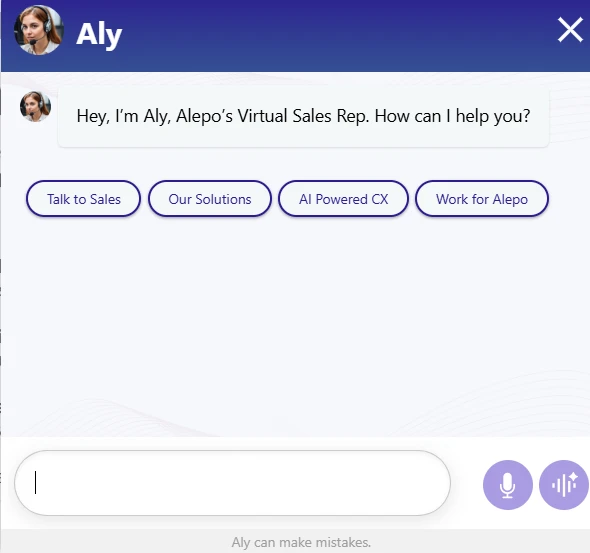
Aly, Alepo’s AI Sales Assistant, is pre-integrated with Alepo’s BSS stack and Salesforce CRM, which compresses the deployment timeline significantly. For operators already running Alepo’s BSS platform, Aly can be live within weeks. Aly qualifies inbound interest, schedules meetings with AEs, and guides prospects through the full Alepo solution portfolio in any language, around the clock.
Aly is powered by fifthelement.ai, an enterprise AI agent platform the same platform that drives the Lüm Mobile deployments. You can also explore how Aly extends into post-sale support through the AI CCaaS Assistant for telecom.
Expert Take — Why Pre-Integration Matters More Than Feature Lists
Most AI sales platform evaluations focus on feature checklists: Does it support multilingual? Does it integrate with Salesforce? The more important question is: how long does integration actually take, and what breaks during it? For operators already on Alepo’s BSS stack, Aly’s pre-integrated architecture means the knowledge base is already seeded with product data. That cuts weeks from the deployment timeline and dramatically reduces the risk of the AI hallucinating product capabilities during early live conversations.
For independent context on AI adoption in telecommunications, the TM Forum’s research on digital transformation in CSPs provides useful benchmarking data on where operators are in their automation journey.
If you’re evaluating where AI fits within a broader BSS modernization program, the BSS migration risk guide covers the integration and change management considerations in detail.
Frequently Asked Questions:
AI sales automation for telecom operators uses AI agents to qualify website visitors, answer complex product questions, schedule meetings, and log leads to CRM automatically and 24/7. Unlike generic chatbots, telecom-trained AI understands BSS, AAA, and AI CX portfolio complexity without human intervention.
A telecom AI sales platform integrates with your CRM (Salesforce, HubSpot), BSS, and self-care portals via standard APIs. Alepo’s Aly, powered by fifthelement.ai, is pre-integrated with Alepo’s BSS stack and Salesforce CRM, enabling faster deployment in most operator environments.
Deployment timelines depend on integration complexity. With Alepo’s Aly, pre-integrated with the Alepo BSS stack, most operators are live within weeks. Greenfield deployments with custom CRM integrations typically take 4–8 weeks. A proof of concept can be operational in days.
Based on Alepo customer deployments, operators using AI sales assistants have seen significant attribution of sales volume to AI-driven interactions within the first two months, high first-contact resolution rates, and measurable reductions in subscriber churn through proactive AI engagement. Most operators see measurable pipeline impact within 60 days of go-live.
Deployment timelines depend on integration complexity. With Alepo’s Aly, pre-integrated with the Alepo BSS stack, most operators are live within weeks. Greenfield deployments with custom CRM integrations typically take 4–8 weeks. A proof of concept can be operational in days.