TACACS+ Server

TACACS+ Server for Secure Network Device Administration

Alepo TACACS+ Server is a carrier-grade, enterprise-class solution that centralizes privileged administrative access across your network infrastructure. It authenticates every privileged login, authorizes every command, and records every session, all from a single policy point. NetOps and security teams know exactly who can reach each device and what they are permitted to do on it.

Why Network Device Administration Needs a TACACS+ Server

Without a TACACS+ server, device access usually runs on shared local credentials, with the same passwords sitting on hundreds of devices and no per-user accountability.

Individual Accountability

Every administrative action on every device is tied to a named individual. When a configuration changes, you know who, what, where, and when.

Enforced Least Privilege

A NOC operator runs show commands. Only senior engineers touch the running config. Privilege levels are enforced by policy, not left to convention.

Audit Readiness

Per-user access records give security frameworks and regulators the evidence they require, and SIEM and firewall integration ties them into incident workflows.

Platform Consolidation

TACACS+ runs natively on the same Alepo platform that handles RADIUS and Diameter. There is no separate point product to license, patch, and maintain.

Gemini_Generated_Image_biz5z8biz5z8biz5

What Is a TACACS+ Server?

TACACS+ (Terminal Access Controller Access-Control System Plus) is a protocol built for controlling administrative access to network devices. It belongs to the AAA protocol family, but serves a different purpose than subscriber-facing AAA: RADIUS and Diameter authenticate the subscribers and devices that use the network, while TACACS+ governs the engineers who administer it.

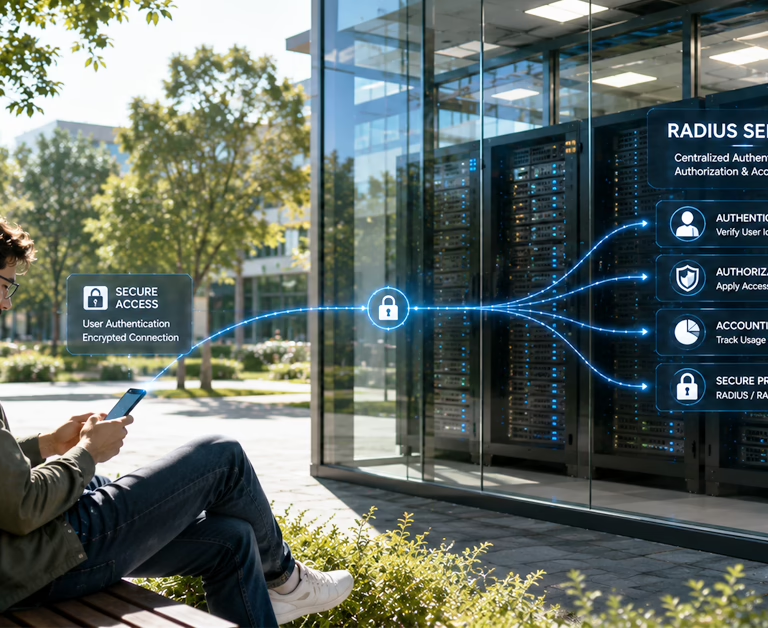
A TACACS+ server is the central decision point for that protocol. When an engineer logs in to a router, switch, or firewall, the device forwards the request to the TACACS+ server, which answers three questions. Authentication: is this person who they claim to be? Authorization: which commands may they run on this device? Accounting: what did they do, and when?

How Alepo Secures Device Administration

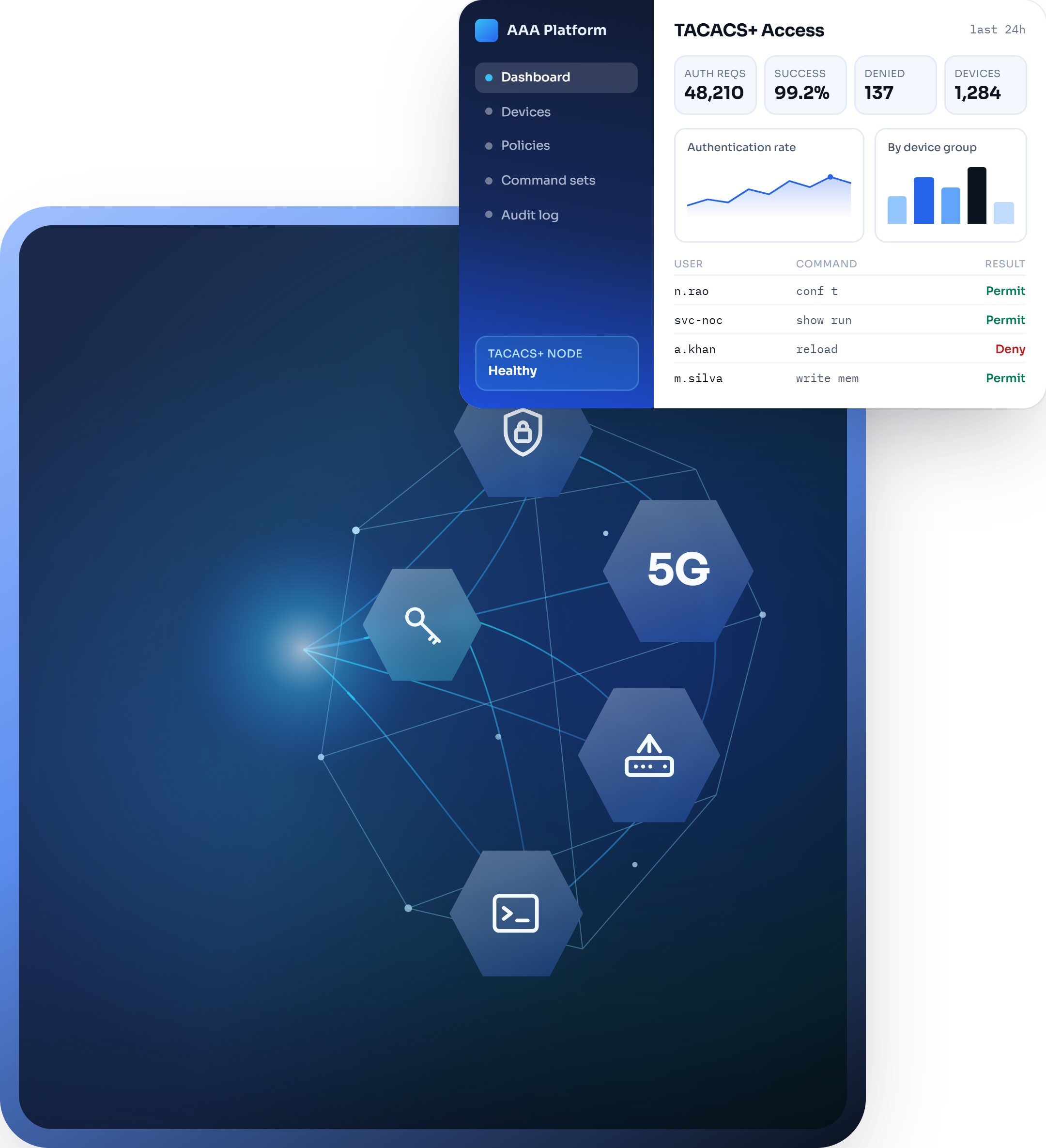
Alepo delivers TACACS+ device administration through five capabilities, all running natively on one platform.

  • Individual Credentials: Every administrator signs in with their own credentials, validated centrally, eliminating shared device passwords across the entire estate
  • Existing Identity Stores: Integrates with the LDAP and SQL identity stores you already run, so there is no parallel user database to build or maintain
  • Multi-Realm Isolation: Separate teams, regions, and business units stay cleanly partitioned, each with its own administrators and policies
  • Per-Command Control: Each command an administrator runs is approved or denied in real time, per user and per role, driven by centrally defined policy
  • Role-Based Access: NOC operators, field engineers, and senior administrators each receive exactly the access their role requires
  • One Policy Point: When a role changes, one policy update applies everywhere instantly, instead of a device-by-device reconfiguration
  • Complete Capture: Every login, session, and authorized command is recorded with user identity and timestamps
  • Investigation Ready: Security investigations get a queryable answer to who did what, where, and when
  • Compliance Evidence: Per-user records available on demand, instead of a manual log-collection exercise across hundreds of devices
  • Real-Time Analysis: The Alepo AI Agent for AAA analyzes TACACS+ logs for unauthorized access, brute-force, and credential-stuffing attempts
  • Privilege Escalation Detection: Behavioral threat hunting surfaces anomalous administrator activity before it becomes an incident
  • Automated Response: Detections can trigger your SIEM and firewalls automatically
  • Built In, Not Bolted On: Part of the Alepo platform, not a separate product to buy and integrate
  • Active-Active Geo-Redundancy: Device administration is the tool you need most during an outage, so the TACACS+ service stays available through site failures
  • Any Infrastructure: Containers on Kubernetes, VMs, bare metal, private cloud (AWS, Azure, GCP), or on premises
  • Fully Managed Option: Run it yourself or have Alepo operate it, with the same capabilities in every deployment model
Gemini_Generated_Image_sz4fc6sz4fc6sz4f (1)

See Command-Level Control in Action

Watch an administrator session flow end to end: login, per-command authorization, full audit capture, and a flagged privilege-escalation attempt, on your choice of infrastructure.

Why Choose Alepo as Your TACACS+ Server?

20+ years building carrier-grade AAA, 35+ global deployments, and Tier-1 operators in production worldwide. One standards-based, 3GPP-compliant platform for RADIUS, Diameter, and TACACS+, interoperable with any TACACS+-capable device.

Beyond End-of-Life ACS

Cisco Secure ACS has reached end-of-life, and many operators still depend on it or on unsupported DIY daemons. Alepo provides a supported, enterprise-class migration path.

Not a Point Product

Dedicated device-administration tools deliver TACACS+ and nothing else. Alepo delivers the same command-level control as a native protocol on its AAA platform, alongside RADIUS and Diameter.

Intelligence, Not Just Logs

Most TACACS+ servers record what happened. Alepo also tells you what it means, converting device-administration telemetry into live threat detection with automated response triggers.

Carrier-Proven Performance

99.999% availability with active-active geo-redundancy keeps the service reachable through site failures, and horizontal scaling grows capacity with your device fleet.

Alepo TACACS+ Server
Frequently Asked Questions

TACACS+ (Terminal Access Controller Access-Control System Plus) is a AAA protocol that controls administrative access to network devices. When an engineer logs in to a router, switch, or firewall, the device forwards the request to a TACACS+ server.

The server then does three things: it authenticates the user, authorizes the commands they may run, and records everything they do. That combination is what turns device access from a shared-password free-for-all into something you can govern and audit.
The short answer is that they solve different problems, and most networks need both.

TACACS+ is designed for device administration. It runs over TCP on port 49, encrypts the full packet payload, separates authentication from authorization, and supports per-command control.

RADIUS is designed for network access. It runs over UDP, encrypts only the password field, and combines authentication with authorization.

TACACS+ governs the engineers who manage the network; RADIUS handles the subscribers and devices that use it. Alepo runs both natively on one platform.
Local accounts mean shared passwords replicated across hundreds of devices, no per-user accountability, and slow offboarding. When someone leaves, you are chasing credentials device by device.

A TACACS+ server centralizes identity, enforces least-privilege command control, and records a complete audit trail. A credential change or a departure is handled once, centrally, rather than device by device.
Yes. Cisco Secure ACS has reached end-of-life, and many operators are still running it or a DIY daemon with no vendor support behind it.

Alepo provides a supported, enterprise-class replacement for TACACS+ device administration, with a migration path that does not require adopting a broader access-control suite or moving into a new vendor ecosystem.
TACACS+ is standards-based, so Alepo works with any TACACS+ capable device: routers, switches, firewalls, BNG/BRAS, and wireless controllers.

The platform already integrates with WLC/AP vendors including Cisco, Aruba, Ruckus, Huawei, and Mikrotik, and with BNG/BRAS platforms from Cisco, Nokia, and Juniper.
As containers on Kubernetes, on VMs, on bare metal, in private cloud (AWS, Azure, GCP), on premises, or as a fully managed service operated by Alepo.

Every deployment model supports active-active geo-redundant configurations for high availability, which matters more here than elsewhere, because device administration is the tool you need most during an outage.

Subscribe to our Newsletter

Receive the latest news

Subscribe To Our Newsletter