Overview
- Zero Trust replaces trust based on network location with a decision made on every access request. NIST (National Institute of Standards and Technology) SP 800-207 sets this out as seven tenets, including that all communication is secured regardless of location and that authentication and authorization are “a constant cycle.”
- In NIST’s model that decision is made by a policy decision point (PDP) and applied by a policy enforcement point (PEP). In a telecom network those roles already exist: the AAA server is the PDP, and the network access server (NAS), broadband network gateway, or wireless LAN controller is the PEP.
- RADIUS (Remote Authentication Dial-In User Service), Diameter, and TACACS+ (Terminal Access Controller Access-Control System Plus) are the protocols that carry the decision between them. Change of Authorization (CoA) is how the decision is revised mid-session, which is the tenet most architectures fail.
- Most operators therefore do not need a new Zero Trust product to start. They need their existing AAA layer to be capable of dynamic policy, continuous reauthorization, and detection on the transaction. That is an AAA modernization question, not a Zero Trust procurement question.
Every Zero Trust diagram you have seen was drawn for an enterprise IT network: a user, a laptop, applications behind a policy enforcement point, an identity provider off to one side. It is a useful picture, and it maps onto almost nothing in a carrier network, where the “users” are subscriber sessions at carrier scale and the access layer is a broadband network gateway rather than a cloud proxy.
So the question worth asking is not whether Zero Trust applies to telecom. It is which component already does that job and in a carrier network it is the AAA layer. The devices there include set-top boxes and industrial IoT (Internet of Things) modules that cannot run an agent, which rules out most of what the enterprise diagram assumes.
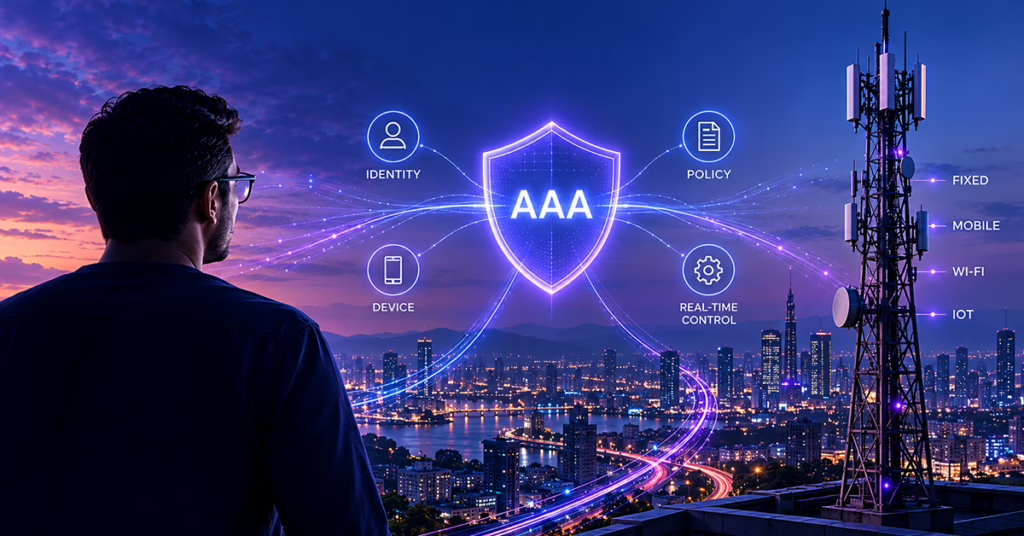
In a Zero Trust architecture, the AAA (authentication, authorization, and accounting) server functions as the continuous verification layer: it authenticates and authorizes every access request against dynamic policy, and it can revise or revoke a session after access is granted, rather than trusting that session for its lifetime.
What Zero Trust actually means for a telecom network
Zero Trust is not a product category, and the shorthand everyone quotes is not the definition. “Never trust, always verify” came out of Forrester research by John Kindervag. The specification people build against is NIST SP 800-207, published in August 2020, which sets out seven tenets rather than a slogan.
Four of those tenets do the real work. All communication is secured regardless of network location, so a request from inside the operator’s own infrastructure meets the same requirements as one from outside. Access is granted per session, with least privilege. Access is determined by dynamic policy that takes in identity, device state, behavioral attributes, and environment. And all resource authentication and authorization are dynamic and strictly enforced before access is allowed. NIST describes that as “a constant cycle of obtaining access, scanning and assessing threats, adapting, and continually reevaluating trust in ongoing communication.”
That last phrase rules out the reading most vendors sell. Zero Trust is not a stricter login. It removes the assumption that a decision made at the start of a session stays correct for the rest of it, which is a much harder thing to build.
Zero Trust versus perimeter security in a telecom network
Perimeter security answered a real constraint: when verification is expensive, you verify once at a boundary and treat everything inside it as known. In a carrier network that logic shows up in familiar places. A management VLAN (virtual local area network) where reaching the jump host is most of the authorization. An interconnect trusted because it terminates on your own equipment. An enterprise Wi-Fi service where the association is checked and the session is then left alone for eight hours.
NIST has a name for the space behind such a boundary: an implicit trust zone, where entities are trusted once past the gateway. The guidance does not say to abolish it, because you cannot. It says to shrink it, by moving the policy decision and enforcement points closer to the resource.
Telecom networks have a specific reason to care. The estate is not one perimeter but many, and the interesting attacks arrive holding a valid credential: a reused subscriber password, a contractor’s certificate that should have been revoked last month. Against a credential that is valid at the perimeter, the perimeter has nothing left to say.
Where AAA fits in a Zero Trust architecture: the continuous verification layer
NIST splits the Zero Trust core into a policy decision point and a policy enforcement point. The decision point is made up of a policy engine that reaches the access decision and a policy administrator that establishes or tears down the session; the enforcement point enables, monitors, and terminates the connection to the resource.
A telecom network has run that exact split for as long as RADIUS has been deployed, under other names. The AAA server is the policy decision point: it evaluates the request against policy and decides. The NAS, broadband network gateway, wireless LAN controller, or the ePDG (evolved packet data gateway) that terminates Wi-Fi calling is the policy enforcement point: it holds the session open and drops it on instruction. RADIUS, Diameter – with 3GPP (3rd Generation Partnership Project) TS 29.273 defining the S6b and SWx interfaces and TACACS+ carry the request from the enforcement point to the decision point, and the decision back. Our guide to RADIUS, Diameter and TACACS+ sets out which protocol serves which access path.
That direction matters: the enforcement point starts the exchange, so a granted session is not revisited unless something forces the question again.
The commercial consequence is that most Zero Trust pitches to operators are framed backwards. Zero Trust is sold as something to add, when the architecture is already in place and correctly shaped. What varies is whether the AAA platform sitting in the PDP role can satisfy the tenets. A server that checks a credential against a static table and returns a fixed profile occupies the decision point without doing dynamic policy. It is Zero Trust-shaped and not Zero Trust.
Zero Trust tenets mapped to telecom network and AAA implementation
| Zero Trust tenet (NIST SP 800-207) | Telecom / AAA application |
| All communication is secured regardless of network location | Subscriber sessions, enterprise Wi-Fi associations, and administrator logins to routers and switches are each authenticated through the AAA layer. Terminating on your own access network grants no implicit trust; device administration moves off shared local passwords onto centralized TACACS+ |
| Access to individual resources is granted per session, with least privilege | AAA authorization returns a policy per session rather than a blanket profile: service type, bandwidth and access rules, realm (authentication domain) scope. TACACS+ per-command authorization applies the same principle to network device administration, one command at a time |
| Access is determined by dynamic policy using identity, device state, behavioral attributes, and environment | The AAA policy decision evaluates the full request at decision time: identity and EAP (Extensible Authentication Protocol) method, NAS and port, calling station, access type, and the subscriber’s live session state and authentication history – not just a credential lookup |
| Authentication and authorization are dynamic and strictly enforced as a constant cycle | Reauthentication timers and IEEE 802.1X periodic reauthentication, RADIUS accounting Interim-Updates as the ongoing signal, and Change of Authorization or Disconnect-Message (RFC 5176) to change or end a session already in progress |
Continuous authentication in practice: how AAA re-verifies a live session
The fourth row is where implementations usually fall short. An operator sells a managed enterprise Wi-Fi service. A contractor’s laptop associates at 09:00 and authenticates by EAP-TLS against the AAA server, which validates the certificate and applies the contractor policy. At 11:00 the contract ends and the enterprise revokes the certificate in its PKI (public key infrastructure). The laptop is still associated, still passing traffic, and still inside a session authorized two hours ago against a credential that is no longer valid.
Here is the part most Zero Trust material skips. Nothing about that revocation reaches the AAA server on its own, because certificate status is pulled rather than pushed. The server checks a certificate revocation list or an OCSP (Online Certificate Status Protocol) responder when it authenticates, and nothing tells it to revisit live sessions. Something has to force the question again, and there are two ways.
Periodic reauthentication is the first. When the timer fires the revocation check runs again and the session drops. That bounds the exposure honestly: the reauthentication interval is the worst case between a credential going bad and the network acting on it. It is also why deployments quietly lengthen or disable that timer, and every hour added is an hour added to the window.
An external trigger is the second. A network access control platform, or an integration from the enterprise’s PKI, calls the AAA platform. The platform then acts as what RFC 5176 calls a dynamic authorization client, and sends a CoA to the wireless LAN controller to quarantine the session, or a Disconnect-Message to drop it. Note the role reversal: the AAA server is the RADIUS server, but in dynamic authorization it is the client and the NAS is the server. That is how a decision point revises a decision it already made, and it is the difference between a Zero Trust diagram and a Zero Trust network.
Underneath both sits accounting, including Interim-Updates, what NIST’s seventh tenet asks an operator to collect and act on. Where that detection sits decides whether anything acts on it, and our cloud-native AAA architecture guide describes where it belongs in a containerized deployment.
This is the model Alepo AAA Server is built on. The Alepo AI Agent for AAA runs on the AAA platform itself and turns RADIUS, Diameter, and TACACS+ telemetry into a security control plane. It performs anomaly detection on unauthorized access, brute-force and credential-stuffing detection, privilege-escalation and policy-violation detection, and DDoS (distributed denial of service) prediction, with SIEM (security information and event management) and firewall trigger integration. Because the detection runs on the AAA platform rather than on a copy of its logs elsewhere, the platform that recognizes the anomaly is the one that can act on the session through CoA. Alepo AAA Server is engineered for 99.999% availability and rated at 36,000+ TPS capacity on a stateless, clustered design (AAA Server datasheet) the envelope continuous verification has to fit inside.
Zero Trust Network Access and telecom infrastructure
Zero Trust Network Access, or ZTNA, is a product category, and conflating it with Zero Trust causes real confusion in telecom conversations. ZTNA products broker access from a user to a private application, typically replacing a VPN, granting no network-level reachability. For an operator’s corporate IT that is a reasonable purchase. It has nothing to do with the network you sell.
For carrier infrastructure the useful reading of ZTNA is the principle underneath it: reachability should not be a consequence of being connected. Two places benefit directly. Administrative access to network elements is the clearer. Centralized TACACS+ authentication, per-command authorization, and the command-level record described in our guide to TACACS+ accounting and audit logs deliver that principle for the people who can change the network. The second is the enterprise and IoT services operators sell, where per-session policy from the AAA layer decides what a connected device may reach.
The distinction to keep is that a ZTNA product secures access to applications, while the AAA layer secures access to the network itself. In a telecom estate the second is much the larger surface, and it is not what a ZTNA product is built to cover. A useful test: if a Zero Trust proposal for your network arrives without a section on RADIUS, Diameter, or TACACS+, it is a proposal about your corporate IT.
The business case for Zero Trust in telecom
Zero Trust adoption in telecom is usually driven from outside the security team. Enterprise customers send security questionnaires asking how sessions are authorized and how fast access can be revoked, and regulators in many markets expect continuous verification language in submissions about critical network functions. Neither asks whether you have bought a Zero Trust product; both ask what happens when a credential goes bad. And the answer is a number: your reauthentication interval, or your dynamic-authorization path if you have one.
That makes the internal case easy to frame and hard to fake. Use the measures an incident response program already reports: time to detect and time to contain. A Zero Trust posture at the access layer moves detection from after log export to during the transaction, and containment from a cross-team ticket to an action on the platform that owns the session.
Two cautions belong in an honest version of this case. Zero Trust is a direction of travel rather than a state you reach, so a plan promising to “achieve Zero Trust” by a date will not survive a security architect. And the work is mostly unglamorous: shrinking implicit trust zones, replacing static policy with dynamic policy, turning reauthentication back on.
Starting Zero Trust in your telecom network with AAA
Start by auditing the policy decision point you already have. Four questions settle it. Can your AAA platform authorize on attributes beyond a credential match, including session state and history? Can it change or terminate a session already in progress through CoA, and is that path tested rather than theoretically supported? Is device administration centralized on TACACS+ with per-command authorization? And can anything on the platform detect a reason to act while the session is live, or does detection live in a tool reading yesterday’s exports?
Where the answers are no, you have found the Zero Trust work, and it is AAA modernization under a different name. Map the tenets onto your own access, enterprise, and administration paths, mark each supported, partial, or absent, and let the gaps set the order. The framework is worth borrowing because it is familiar to the people approving the budget. The implementation is the AAA layer you already own.
See continuous verification on a live session
Bring the revocation scenario from your own estate. We will walk through it on Alepo AAA Server: how the authorization condition changes mid-session, and how the CoA reaches the enforcement point while the rest of the subscriber base carries on untouched. Your security architects can see the constant cycle work rather than read about it.
Frequently asked questions
Q1. How does Zero Trust apply to telecom networks?
By replacing trust based on network location with a policy decision on every access request, and by shrinking the implicit trust zones that sit behind each boundary. In practice that means subscriber sessions, enterprise services, and administrator logins are each authorized against dynamic policy through the AAA layer, and those authorizations can be revised while the session is still live.
Q2. Where does AAA fit in a Zero Trust architecture?
The AAA server is the policy decision point. In NIST SP 800-207 terms it performs the policy engine function of reaching the access decision and the policy administrator function of establishing or tearing down the session, while the network access server, broadband network gateway, or wireless LAN controller acts as the policy enforcement point. RADIUS, Diameter, and TACACS+ carry the decision between the two.
Q3. What does “never trust, always verify” mean for telecom security?
That no session is trusted because of where it connects from or because it was authenticated earlier. Every access request is evaluated against current policy, and a session already granted can be reauthorized or terminated when the conditions behind the original decision change. The phrase is industry shorthand, from Forrester research by John Kindervag; NIST SP 800-207 expresses the same idea as seven tenets.
Q4. How is Zero Trust different from traditional perimeter security?
Perimeter security verifies at a boundary and then treats everything behind it as known, which creates an implicit trust zone. Zero Trust moves the decision and enforcement points closer to the resource so each session carries its own authorization. The practical difference shows against a valid but compromised credential, which passes a perimeter check without difficulty.
Q5. What role does continuous authentication play in Zero Trust?
It implements the tenet that authentication and authorization are a constant cycle rather than a one-time event. In telecom that is carried by IEEE 802.1X periodic reauthentication, RADIUS accounting Interim-Updates as the ongoing session signal, and Change of Authorization or Disconnect-Message to revise or end a session in progress. A live session is only re-evaluated when something forces the question, either the reauthentication timer firing or an external system triggering dynamic authorization, so the reauthentication interval sets the worst-case window between a credential going bad and the network acting on it.
Q6. Can a telecom network implement Zero Trust without upgrading AAA infrastructure?
Only partially. The architecture is already correctly shaped, so nothing new has to be bought to occupy the policy decision point. But a platform that matches a credential against a static table and returns a fixed profile cannot do dynamic policy or mid-session reauthorization, which are two of the four tenets that matter most. Where those are missing, the Zero Trust work is AAA modernization.
Q7. What’s the business case for Zero Trust in telecom networks?
It is usually driven by enterprise customers’ security questionnaires and by regulatory expectations around critical network functions, both of which ask what happens when a credential goes bad rather than which product you bought. Internally, frame it on the two measures an incident response program already reports: time to detect and time to contain.
Q8. How do I start implementing Zero Trust principles in my telecom network?
Audit the policy decision point first. Establish whether your AAA platform can authorize on attributes beyond a credential match, whether CoA and session termination are tested in production, whether device administration is centralized on TACACS+ with per-command authorization, and whether anything detects a reason to act while a session is live. Map the tenets across your access, enterprise, and administration paths, then let the gaps set the sequence.